Tracy parents comparing preschool options eventually run into this exact question: Montessori or traditional? Both terms get thrown around a lot, often without much explanation of what actually happens differently inside the classroom. This guide breaks down the real, practical differences, not just the philosophy buzzwords, so you can make a decision based on how your specific child actually learns.
Quick answer: Montessori preschool emphasizes child-led, self-directed learning through hands-on materials, while traditional preschool follows a more teacher-directed curriculum with structured group activities. Neither is universally “better.” The right fit depends on your child’s temperament. Keep reading for the full breakdown, or call us directly and we’ll help you figure out which approach fits your family based on what we see work locally.
Why This Decision Actually Matters
Preschool isn’t just childcare while you’re at work. For most Tracy families, it’s your child’s first real exposure to structured learning, and the philosophy behind that structure shapes how your child experiences school for years afterward. A child who thrives with clear routines and teacher-led instruction can genuinely struggle in a self-directed Montessori environment, and vice versa. Getting this fit right matters more than most parents realize going in.
What Montessori Preschool Actually Looks Like
Montessori education, developed by Dr. Maria Montessori over a century ago, is built around the idea that children learn best through hands-on exploration, self-direction, and a carefully prepared environment rather than direct instruction.
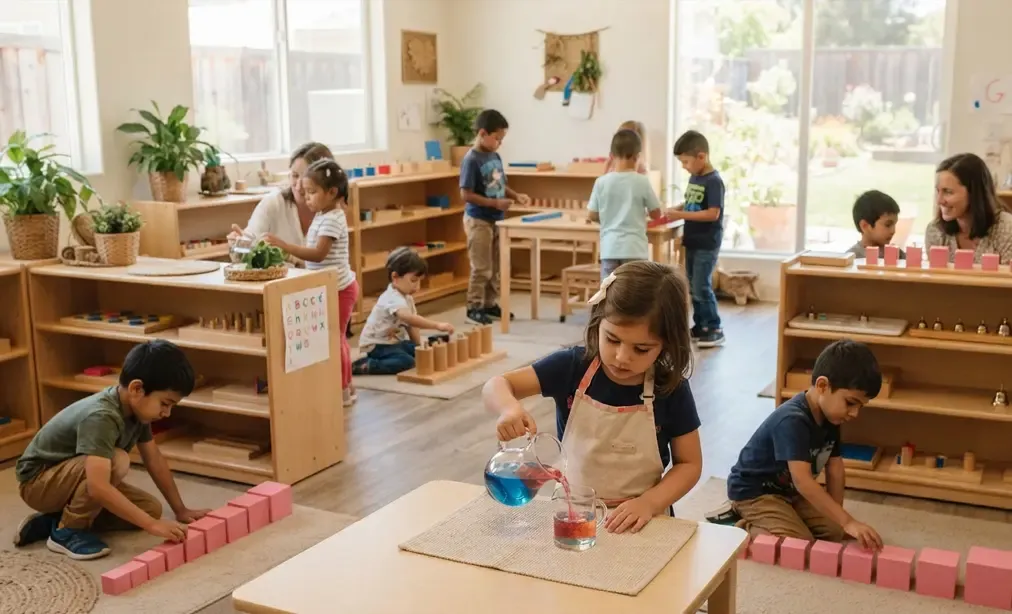
In a real montessori school classroom, you’ll typically see:
- Children moving freely between different learning stations, choosing their own activities rather than following a group schedule
- Specialized materials designed for a specific developmental purpose, like pouring exercises, sorting trays, or number rods
- Mixed-age classrooms, often spanning a two to three year age range, where older children naturally mentor younger ones
- Teachers acting as guides who observe and gently redirect, rather than standing at the front leading a lesson
- Long, uninterrupted blocks of work time, sometimes two to three hours, allowing children to fully engage with an activity without rushed transitions
What Montessori Actually Builds
- Independence — children are expected to complete tasks themselves, from pouring their own snack to putting materials away
- Concentration — the uninterrupted work periods train sustained focus in a way shorter, more fragmented schedules don’t
- Self-discipline — because the environment relies on internal motivation rather than constant teacher direction, children build genuine self-regulation
- Practical life skills — buttoning, pouring, cleaning up spills, and other real-world tasks are treated as legitimate learning activities, not just chores
What Traditional Preschool Actually Looks Like
Traditional or structured preschool programs follow a more familiar model: a teacher leading the classroom through a planned daily schedule, with group activities, circle time, and academic building blocks introduced on a set timeline.
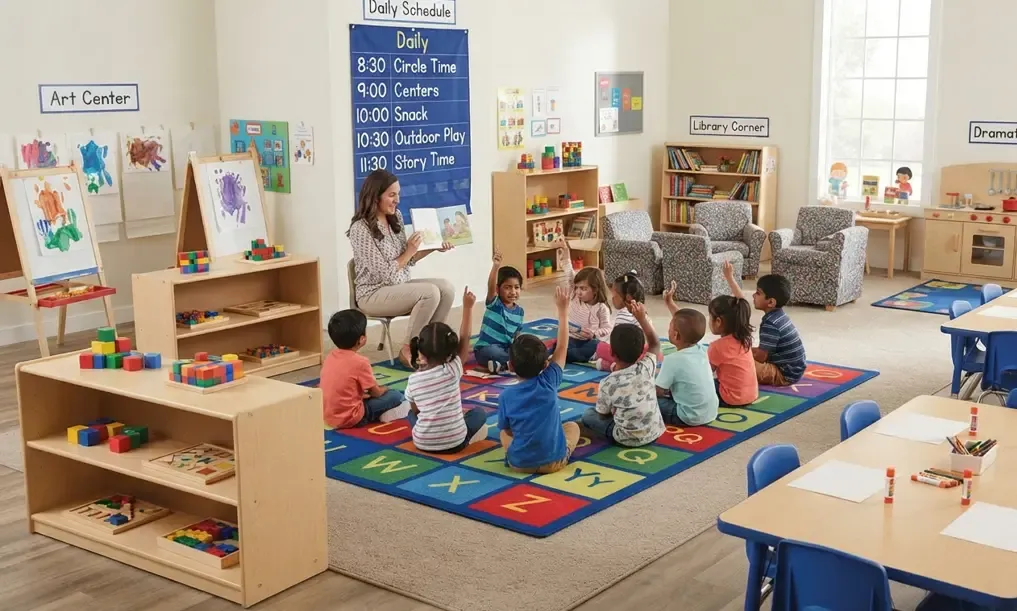
In a traditional classroom, you’ll typically see:
- A structured daily schedule with defined blocks for circle time, learning centers, outdoor play, and rest
- Teacher-led group instruction, including songs, story time, and guided activities
- Single-age classrooms, usually grouped by birth year
- A curriculum that introduces letters, numbers, and early literacy on a planned progression
- More frequent transitions between activities throughout the day
What Traditional Preschool Actually Builds
- Group participation skills — following along with a class, raising a hand, waiting a turn to speak
- Structured routine familiarity — a schedule that closely mirrors what kindergarten will look like
- Early academic exposure — a more direct, planned introduction to letters, numbers, and school readiness concepts
- Adaptability to transitions — practice moving between different activities on a set schedule
Side-by-Side Comparison
| Feature | Montessori | Traditional Preschool |
|---|---|---|
| Learning style | Child-led, self-directed | Teacher-led, structured |
| Classroom age mix | Mixed-age (2-3 year span) | Single-age groups |
| Daily structure | Long uninterrupted work blocks | Scheduled, segmented activities |
| Teacher role | Guide and observer | Instructor and director |
| Materials | Specialized, self-correcting materials | Varied, activity-based materials |
| Academic introduction | Through hands-on exploration | Through planned, direct instruction |
| Best fit for | Independent, focused, self-motivated children | Children who thrive with routine and clear direction |
Which Approach Fits Your Child’s Temperament
This is the question that actually matters more than which philosophy sounds better on paper.
Montessori tends to fit well for children who:
- Show strong independent focus, even for short stretches
- Get frustrated with too much interruption or redirection
- Enjoy repetitive, hands-on tasks
- Are naturally curious and self-motivated to explore
Traditional preschool tends to fit well for children who:
- Respond well to clear routines and expectations
- Enjoy group activities like songs and story time
- Benefit from more frequent teacher guidance and feedback
- Do well with structured transitions rather than open-ended choice
Neither temperament is better than the other. A child who struggles with unstructured choice in a Montessori setting isn’t a bad fit for learning generally, and a child who finds a traditional classroom’s pace too regimented isn’t disruptive by nature. It’s a genuine match question, not a quality question.
How Each Approach Prepares Kids for Kindergarten
Both paths lead to kindergarten readiness, just via different routes.
Montessori-educated children often arrive at kindergarten with strong independence, self-regulation, and task persistence, since they’ve spent years practicing sustained, self-directed focus. What they sometimes need to adjust to is a more teacher-directed classroom pace and larger group instruction format.
Traditionally-educated children often arrive already comfortable with group routines, raising hands, and following a teacher’s lead, since that’s closely mirrored what kindergarten expects. What they sometimes need to build further is independent task initiation without direct instruction.
Neither path disadvantages a child heading into kindergarten. Most children adjust within the first few weeks regardless of their preschool background, particularly with a smooth transition supported at home.
What Tracy Parents Should Actually Ask During a Tour
Rather than asking a provider “are you Montessori or traditional,” which many centers answer vaguely or blend loosely, ask more specific questions that reveal what’s actually happening day to day:
- Can I observe a full morning, including transitions between activities?
- How much of the day is child-chosen versus teacher-directed?
- How do you handle a child who struggles with the pace of the day, whether too structured or too open?
- What does a typical work or activity block actually look like, minute by minute?
- How do teachers introduce early literacy and math concepts?
Watching an actual classroom in session, even for fifteen minutes, tells you more than any brochure describing a philosophy.
Does It Have to Be One or the Other?
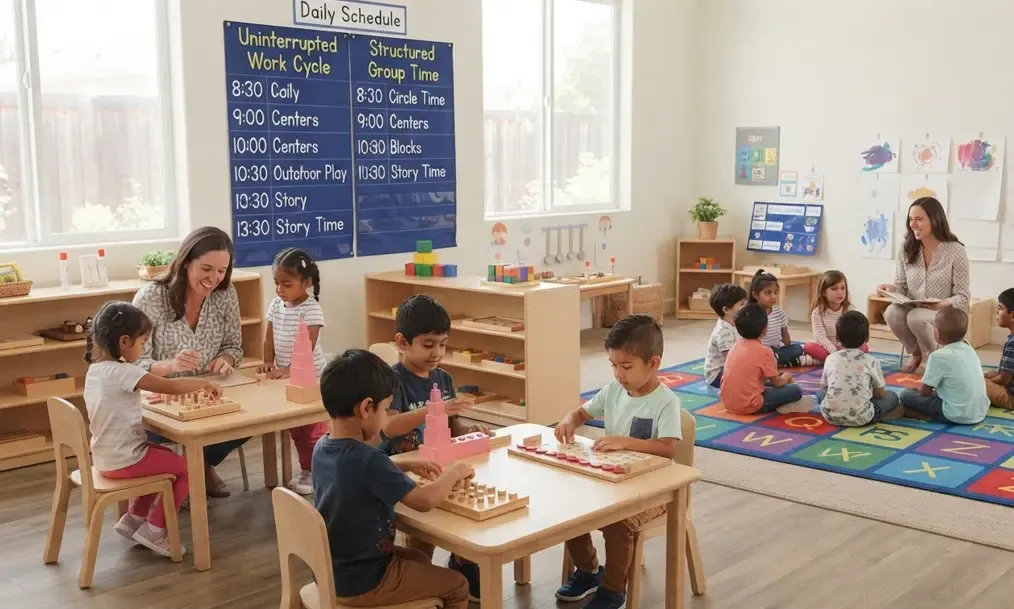
Not entirely. Plenty of programs, including some in Tracy, blend elements of both approaches: incorporating Montessori-style independent work stations alongside more traditional circle time and structured transitions. If your child seems to have traits that fit both descriptions, a blended program might actually be the best fit rather than choosing strictly one philosophy or the other.
What the Research Actually Shows
Academic research comparing Montessori and traditional preschool outcomes has found mixed but generally positive results for both approaches, with the strongest outcomes tied less to the specific philosophy and more to program quality, teacher training, and consistency. According to the National Association for the Education of Young Children, high-quality early childhood programs of any philosophy share common traits: low staff turnover, developmentally appropriate practices, and strong teacher-child relationships, which matter more to long-term outcomes than the specific curriculum label on the door.
The American Montessori Society similarly notes that Montessori’s core strength lies less in any single technique and more in consistent implementation over time, meaning a program only labeled Montessori without genuine fidelity to the method may not deliver the outcomes families expect.
How to Actually Decide for Your Family
Start by honestly considering your child’s current temperament, not an idealized version of how you’d like them to be. If you’re still unsure, our guide on signs your child is ready for daycare can help you assess where your child currently stands developmentally, which often reveals useful clues about which learning environment might suit them best.
It’s also worth reviewing our breakdown of what a 2-year-old is actually learning at daycare, since understanding how learning happens at the toddler stage helps clarify what to expect as that foundation carries into preschool, regardless of which philosophy you eventually choose.
If your child is younger and you’re still deciding on infant care before preschool becomes a consideration, it’s worth knowing that many Montessori-influenced infant and toddler programs begin building independence habits well before the formal preschool years, which can make that later transition smoother either way.
Finding the Right Fit Locally
Tracy has a mix of both Montessori-influenced and traditional preschool options, and the honest truth is that program quality varies more within each category than between the two categories overall. A poorly run Montessori classroom and a poorly run traditional classroom will both fall short, while a well-run version of either can genuinely support your child’s growth.
The best way to actually find out which is right for your child is to see both types of classrooms in person, ask specific questions about daily structure, and trust what you observe over what a website describes.
Ready to see what a real classroom day looks like before you decide? Call us or contact us here to schedule a visit. We’ll walk you through our specific approach and help you figure out honestly, not just as a sales pitch, whether it fits your child’s temperament.
Frequently Asked Questions
Is Montessori better than traditional preschool?
Neither is universally better, since Montessori emphasizes independence and self-directed learning while traditional preschool focuses on structured routine and teacher-led instruction. The right choice depends on your child’s individual temperament and how they respond to structure versus open-ended choice.
Does Montessori prepare kids for kindergarten as well as traditional preschool?
Yes, though the preparation looks different. Montessori-educated children often arrive with strong independence and focus, while traditionally-educated children often arrive more accustomed to group routines, and both groups typically adjust well within the first few weeks of kindergarten.
How do I know if my child would do better in Montessori or traditional preschool?
Consider whether your child thrives with open-ended choice and sustained independent focus, which suggests Montessori, or responds better to clear routines and teacher-led group activities, which suggests a traditional setting. Observing an actual classroom in session is often more revealing than reading about either philosophy.
Can a preschool combine Montessori and traditional teaching methods?
Yes, many programs blend both approaches, offering child-led work stations alongside structured circle time and transitions. This blended model can be a strong option for children who show traits suited to both styles of learning.