Parents often wonder whether daycare genuinely helps a young child grow, or whether it’s simply a place to keep them safe while adults are at work. The honest answer is both matter, but the developmental piece is far more significant than most people realize. A quality daycare setting shapes brain development, language, social skills, emotional regulation, and physical growth during the exact years when a child’s brain is forming the fastest connections it will ever make.
This guide breaks down exactly how daycare supports early childhood development, stage by stage and skill by skill, so Tracy families can understand what’s actually happening behind the scenes of a typical day.
Why the Early Years Matter So Much
A child’s brain develops more rapidly between birth and age five than at any other point in life. During these years, neural connections form at an extraordinary rate, shaped directly by the experiences, relationships, and environments a child is exposed to daily.
The quality of care a child receives during these early years has a measurable, lasting impact on later academic performance, social competence, and emotional resilience. This isn’t a marketing claim. It’s a well-established finding across decades of early childhood development research.
This is exactly why the setting a child spends their weekdays in matters so much, whether that’s infant care, a toddler daycare classroom, or a structured preschool program. Each stage offers a different kind of developmental support, and understanding what’s happening at each one helps parents make sense of what to look for in a provider.
Cognitive Development: Building the Foundation for Learning
Cognitive development covers how children think, reason, solve problems, and process new information. Daycare supports this constantly, often through activities that don’t look academic at all on the surface.
Quality programs build cognitive skills through:
- Puzzles and sorting activities that build early logic and pattern recognition
- Storytelling and read-alouds that build vocabulary and comprehension
- Open-ended play that encourages problem-solving without a single “right” answer
- Early exposure to counting, shapes, and colors through hands-on materials rather than worksheets
- Cause-and-effect toys and activities that build early scientific reasoning
Trained early childhood educators design these activities intentionally, layering skill-building into what looks like ordinary play. A toddler stacking blocks isn’t just passing time. They’re practicing spatial reasoning, balance, and planning, all of which are genuine cognitive building blocks.
How Cognitive Support Differs by Age
| Age Group | Cognitive Focus | Example Activities |
|---|---|---|
| Infants | Sensory exploration, cause and effect | Textured toys, mirrors, simple sound-making objects |
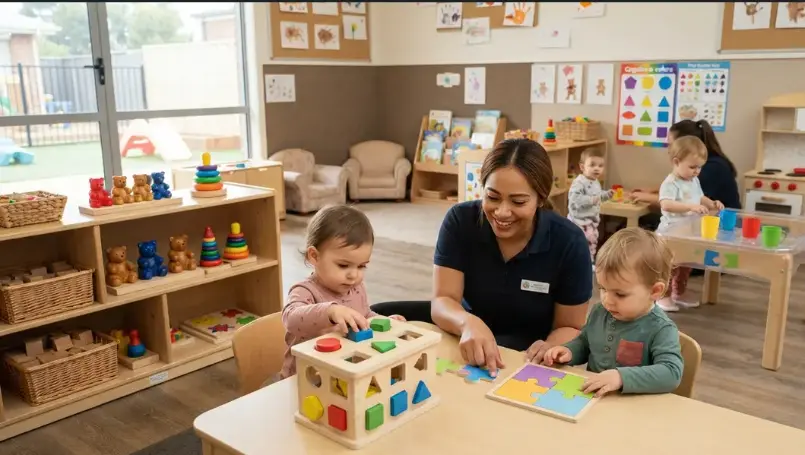
| Toddlers | Early problem-solving, categorization | Shape sorters, simple puzzles, stacking toys |
| Preschool | Early literacy and numeracy | Letter recognition games, counting songs, guided storytelling |
| School age | Applied reasoning and homework support | Structured after-school enrichment, reading practice |
Language and Communication Development
Language development happens fastest in the first five years of life, and group care settings tend to accelerate it in ways that are genuinely difficult to replicate through unstructured time at home alone.
In a quality daycare setting, children are exposed to language through:
- Caregivers narrating activities throughout the day, building vocabulary passively
- Peer conversation and interaction, which introduces new words and phrasing children pick up from each other
- Structured group activities like circle time songs and call-and-response games
- Read-alouds that build comprehension, sequencing, and new vocabulary
Research from the National Institute of Child Health and Human Development has found that children in high-quality daycare programs tend to show stronger language and cognitive skills compared to children in lower-quality settings or informal care arrangements, underscoring just how much provider quality matters here, not simply whether a child is enrolled in daycare at all.
Social Development: Skills That Are Hard to Build at Home Alone
This is one of the clearest, most consistently cited benefits of group care, and it’s also one of the hardest to replicate through unstructured time with a single caregiver.
In daycare, children practice:
- Sharing and turn-taking, even if reluctantly at first, through repeated daily practice with peers
- Reading social cues, like recognizing when a friend is upset or when it’s their turn to speak
- Conflict resolution, learning to navigate small disagreements with caregiver guidance modeling healthy responses
- Group participation, understanding expectations like lining up, waiting, or following shared routines
- Friendship building, developing early relationships that build confidence in social settings
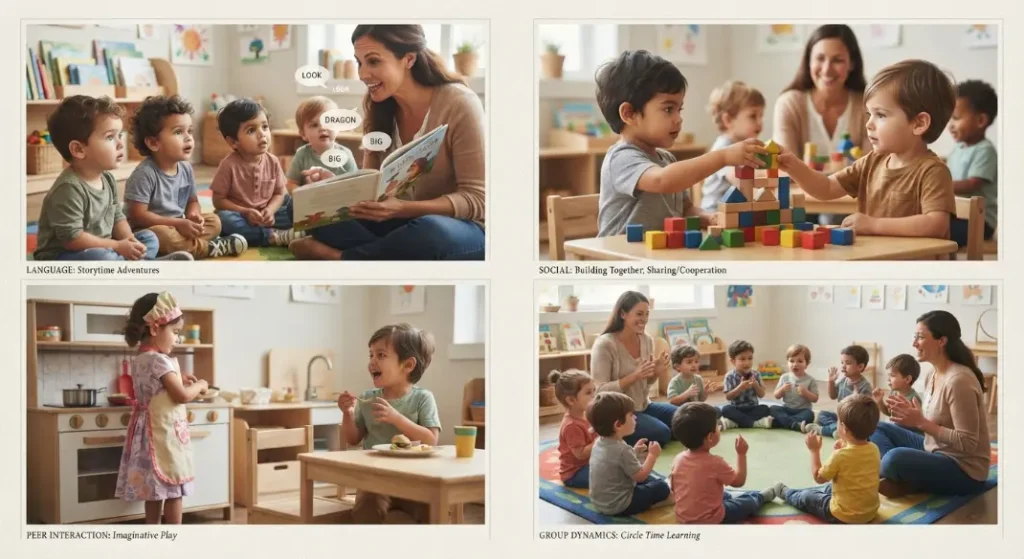
Social-emotional development happens constantly during ordinary daycare moments, group circle time, cooperative play, mealtime conversation, not through any single dedicated “lesson.” This kind of consistent, repeated peer exposure across a full week is genuinely difficult to recreate through occasional playdates alone.
Emotional Development and Regulation
Big feelings are a normal part of early childhood, and quality daycare settings actively support children in learning to understand and manage them.
Caregivers in a well-run classroom typically:
- Name emotions out loud to help children build emotional vocabulary (“I see you’re frustrated”)
- Model calm responses to meltdowns rather than reacting with frustration
- Redirect behavior consistently, helping children learn expectations through repetition
- Encourage simple coping strategies appropriate to the child’s age
This consistent, repeated modeling across a full day, five days a week, tends to build emotional regulation skills faster than occasional modeling at home alone, simply due to the sheer volume of practice a child gets.
Physical Development: Fine and Gross Motor Skills
Physical development is happening constantly during a typical daycare day, often through activities that look like nothing more than play.
Fine motor skills build through activities like:
- Stacking, sorting, and manipulating small toys
- Using crayons, chunky paintbrushes, or child-safe scissors
- Practicing self-feeding with utensils
- Simple puzzle pieces and shape sorters
Gross motor skills build through:
- Outdoor play, climbing, and running
- Group movement activities like dancing or simple obstacle courses
- Practicing balance on age-appropriate playground equipment
A well-structured program balances these deliberately throughout the day rather than leaving physical development to chance, which is one of the reasons a strong daily schedule matters as much as curriculum content.
Independence and Practical Life Skills
This is one of the most overlooked developmental areas, and one that often surprises parents most.
In daycare, children commonly practice:
- Washing their own hands with guidance
- Attempting to feed themselves, even messily
- Helping with simple cleanup tasks
- Taking early steps toward potty training, often in partnership between caregivers and parents
- Putting on simple items like shoes or a jacket with some assistance
Group settings tend to accelerate independence because children see peers attempting these tasks and want to try themselves, something that’s genuinely harder to replicate one-on-one at home, where a parent often steps in to help faster out of convenience.
How This Foundation Connects to Later School Readiness
The skills built during daycare years form a direct foundation for what comes next. Social skills practiced during toddler daycare make preschool transitions smoother. Early language exposure builds toward the literacy foundations children need heading into kindergarten. Emotional regulation practiced consistently tends to ease separation anxiety in later transitions.
If you’re curious what this actually looks like day to day at the toddler stage specifically, our guide on what a 2-year-old is actually learning at daycare breaks down the hidden curriculum behind everyday toddler activities in more depth.
Why Provider Quality Matters More Than Simply Being Enrolled
It’s worth being direct about something research consistently shows: daycare’s developmental benefits depend heavily on quality. High-quality early care has lasting positive effects on language growth, social confidence, and academic readiness, but inconsistent or low-quality care can lead to different outcomes, including behavioral difficulties or insecurity in some children.
This is exactly why choosing the right provider matters as much as the decision to enroll in the first place. Look for:
- Low staff-to-child ratios and low staff turnover
- Caregivers trained specifically in early childhood development
- A curriculum that’s intentional and age-appropriate, not just supervised free time
- Clear, consistent daily communication with parents
- A safe, licensed, well-maintained environment
What This Looks Like Across Different Program Types in Tracy
Different age-specific programs support development differently, and understanding this helps parents know what to expect at each stage.
A quality infant care program focuses on responsive, individualized caregiving, feeding, sleep, and sensory stimulation tailored to each baby’s rhythm rather than a rigid group schedule.
A toddler daycare classroom blends free play with early structure, building language, social skills, and the beginnings of independence.
A preschool program introduces clearer academic scaffolding, early literacy, number sense, and structured group activities that build toward kindergarten readiness.
An after school program shifts focus toward homework support, enrichment activities, and social development among older children, balancing structure with genuine downtime after a full school day.
How Parents Can Reinforce This Development at Home
Daycare provides a strong foundation, but the partnership between provider and parent matters just as much. A few ways to reinforce what’s happening during the day:
- Ask specific questions at pickup about what your child did, not just “how was your day”
- Read together consistently at home to reinforce language development
- Maintain consistent routines between daycare and home when possible
- Stay in communication with your child’s teacher about milestones and any concerns
- Follow up on any specific skills the classroom is currently focusing on
Frequently Asked Questions
How does daycare help with a child’s brain development?
Daycare supports brain development through consistent social interaction, language exposure, and hands-on learning activities during the years when a child’s brain is forming connections fastest. High-quality programs intentionally layer developmental support into everyday play rather than relying on formal instruction alone.
At what age does daycare benefit development the most?
Daycare offers developmental benefits at every age, though the type of support shifts significantly, from sensory and language exposure in infancy to social and academic scaffolding by preschool age. The consistency and quality of care matter more than any single ideal starting age.
Does daycare help with social skills better than staying at home?
Yes, group care settings provide consistent, repeated peer interaction that is difficult to replicate through occasional playdates or time with a single caregiver at home. Children in daycare get daily practice with sharing, turn-taking, and conflict resolution that builds social competence over time.
Is low-quality daycare worse than staying at home?
Research suggests inconsistent or low-quality care can lead to less favorable developmental outcomes compared to high-quality care, which is why choosing a reputable, well-staffed provider matters significantly. Quality indicators like low staff turnover, low ratios, and trained caregivers are worth prioritizing over convenience alone.
How can I tell if a daycare is actually supporting my child’s development?
Ask specifically what a typical day looks like, how caregivers support social-emotional growth, and how they track and communicate developmental milestones to parents. A program that can describe intentional, age-appropriate activities in detail, rather than a general “we keep them busy,” is usually the stronger choice.