
The best daycare in Tracy, CA is one that holds a valid California state license, maintains a low caregiver-to-child ratio, employs qualified and stable staff, follows a structured learning curriculum, communicates with parents daily, operates hours that fit your schedule, offers transparent pricing, accepts financial assistance programs, accommodates your child’s individual needs, and makes you feel completely confident the moment you walk through the door. If a Tracy daycare checks all ten of those boxes, you have found something worth enrolling in.
That answer sounds simple, but for most Tracy parents the reality is anything but. With more than 134 licensed daycare options in Tracy — including 84 home-based programs and 50 licensed centers — the search can feel genuinely overwhelming before you even schedule your first tour. This complete 10 point checklist is written specifically for families in Tracy, California, covering everything from California state law to what your gut is trying to tell you when you step inside a childcare center.
Read it once before you start touring. You will be a far more informed parent by the time you finish.
Why the Daycare You Choose in Tracy Matters More Than You Realize
Early childhood is the single most important developmental window in a person’s life. The Harvard Center on the Developing Child has documented through decades of research that the quality of care, stimulation, and relationships a child experiences between birth and age five shapes brain architecture in ways that affect learning, behavior, and health for the rest of their life.
In Tracy, CA — a rapidly growing city in San Joaquin County where many households include two working parents with Bay Area or Sacramento commutes — finding childcare that is not just available but genuinely excellent is a real and pressing need for families. You are not simply looking for someone to watch your child. You are choosing an environment that will play a meaningful role in who your child becomes.
This checklist reflects that weight. Each of the ten points below is drawn from California childcare law, early childhood development research, and an honest look at what the best and worst daycare programs in Tracy actually look like in practice.
Checkpoint 1 — Confirm the Daycare Is Licensed by the State of California
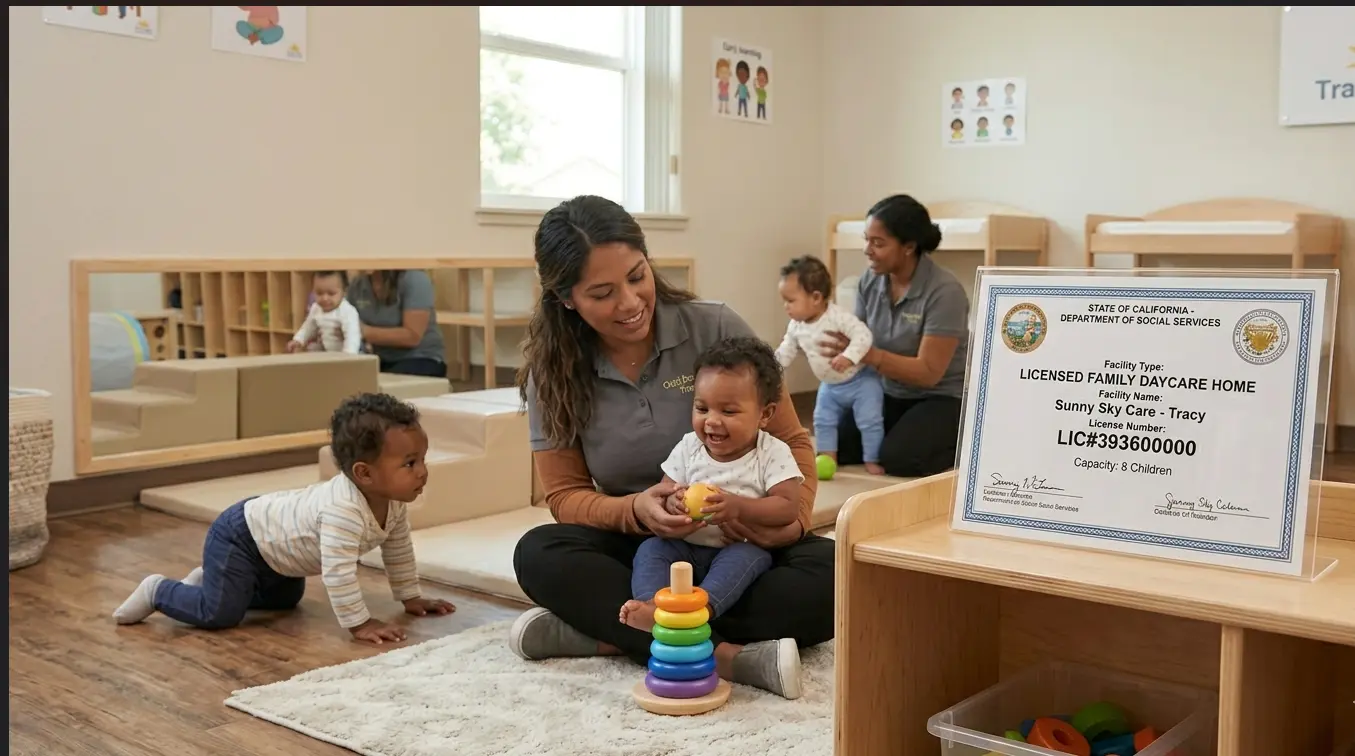
This is the first thing you check, and it is non-negotiable. Every childcare center and family daycare home operating legally in California must hold a current license issued by the California Department of Social Services through its Community Care Licensing Division.
A California daycare license is not just a piece of paper. It means the facility has passed health and safety inspections, meets state-mandated caregiver-to-child ratio requirements, has received fire clearance, and has ensured that every staff member cleared a criminal background check through the Department of Justice. It means the program is accountable to a regulatory authority that can investigate complaints, issue citations, and revoke licenses when standards are not met.
You can verify the license status of any Tracy daycare in under five minutes. Go to ccld.dss.ca.gov, click the facility search tool, and enter the name or address of any Tracy childcare program. You will see the current license status, the licensed capacity, any citations on file, and any substantiated complaints. This is public information and you have every right to review it before you enroll your child.
If a Tracy daycare cannot produce their license number, becomes evasive when you ask about it, or discourages you from checking the state database, treat that as a serious warning and move on.
Checkpoint 2 — Verify the Caregiver-to-Child Ratio
The caregiver-to-child ratio at a Tracy daycare is one of the most direct measurements of care quality available to parents. The fewer children each caregiver is responsible for, the more individualized attention, responsiveness, and supervision your child receives throughout the day.
California’s Title 22 regulations establish the following minimum ratios for licensed childcare centers:
For infants from birth to 18 months: no more than 3 to 4 infants per caregiver. For toddlers from 18 months to 3 years: no more than 6 children per caregiver. For preschool-aged children from 3 to 6 years: no more than 12 children per caregiver.
These are legal minimums. The strongest daycare programs in Tracy operate at ratios meaningfully lower than these thresholds because experienced directors understand what the research has long pointed toward. Lower ratios produce better outcomes. The landmark NICHD Study of Early Child Care — one of the most comprehensive studies of its kind — found that lower caregiver-to-child ratios were among the strongest predictors of positive developmental outcomes across language development, cognitive growth, and social skills.
When you visit a Tracy daycare, do not just ask what the ratio is. Observe it during peak morning hours. Watch what happens at lunch and nap time. Ask specifically what the ratio looks like on days when a caregiver calls in sick. A strong program has a clear and confident answer to that question.
Checkpoint 3 — Evaluate Staff Qualifications and Turnover
A beautiful building with low ratios still falls short if the people caring for your child are underpaid, undertrained, or gone by next semester. Staff quality and stability are the single greatest differentiators between an average Tracy daycare and an outstanding one.
When you sit down with a director during a tour, ask these questions directly and listen carefully to the answers.
What early childhood education credentials do your teachers hold? The California Child Development Permit matrix, administered by the California Commission on Teacher Credentialing, sets the professional standard for early childhood educators in this state. Look for teachers who hold at minimum a Child Development Associate credential, an Associate’s degree in Early Childhood Education, or a California Child Development Teacher Permit. Lead teachers in licensed California centers are required to meet specific education and experience requirements under Title 22.
How long have your caregivers been with this program? Staff turnover is one of the most reliable indicators of a daycare’s overall health as an organization. High turnover means children experience constant changes in their caregivers, and for young children who are still building their sense of security and trust, that instability matters enormously. A Tracy daycare where teachers have been with the program for multiple years signals stable management, fair compensation, and a workplace culture worth staying in.
What ongoing professional development do your staff members receive? Quality programs invest in regular CPR and First Aid recertification through the American Red Cross or American Heart Association, annual training in early childhood development and social-emotional learning frameworks, and continuing education aligned with California’s Quality Counts childcare improvement system.
Checkpoint 4 — Inspect the Physical Environment for Safety and Cleanliness
Your child will spend many hours each week in this environment. What you observe during a tour tells you a great deal about how the program is actually run every single day, not just how it looks when parents are coming through.
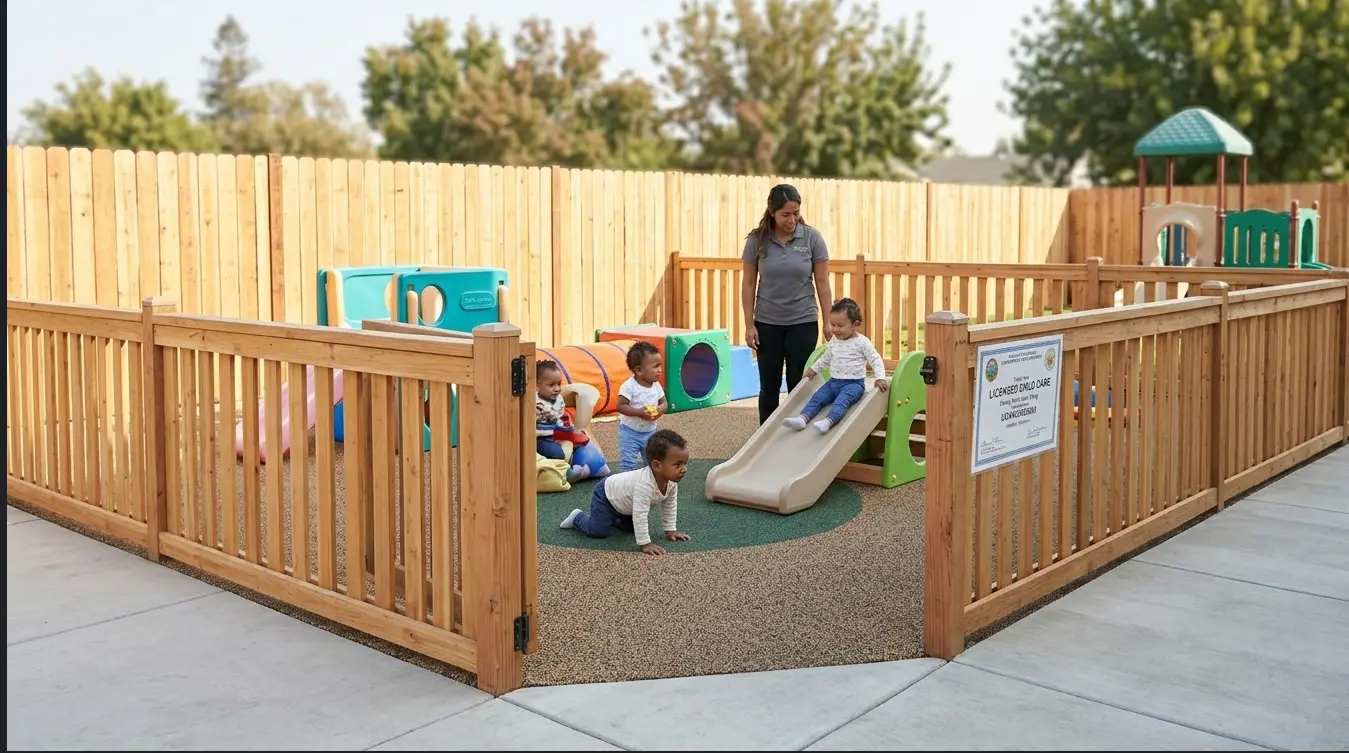
Walk slowly and look carefully. Are electrical outlets covered throughout the facility? Are climbing structures in the outdoor play area age-appropriate, free of rust or splinters, and cushioned underneath with rubberized surfacing? Is the outdoor space fully fenced with a secure latching gate? Are there clear sight lines throughout the indoor classrooms so no area is hidden from a caregiver’s view?
Pay close attention to bathroom and diaper changing areas. The American Academy of Pediatrics recommends specific handwashing procedures and surface sanitation protocols for licensed childcare settings, and a professional daycare in Tracy should be following them every time, not just when someone is watching. Ask to see how diaper changes are handled and how hands are washed before food is prepared or distributed.
Look at the overall condition of the facility during your mid-morning visit. A daycare that is immaculate only during scheduled tours and chaotic every other hour is communicating something important about its real standards. The best Tracy daycare programs look essentially the same whether you visit with advance notice or stop by without calling ahead.
Ask where cleaning supplies and medications are stored. Hazardous materials must be locked and stored out of children’s reach under California childcare licensing regulations. Unlocked cabinets containing chemicals within a child’s reach constitute a citation-worthy violation.
Checkpoint 5 — Understand the Curriculum and Learning Philosophy
Not every Tracy daycare teaches the same way, and not every approach suits every child. Understanding the curriculum philosophy of a center before you enroll prevents frustration, mismatched expectations, and the stress and disruption of switching programs later.
The most common early childhood education philosophies you will encounter at Tracy childcare programs include the following.
The Montessori Method, developed by Dr. Maria Montessori, uses specifically designed learning materials, child-led exploration, and mixed-age classrooms to build independence, concentration, and intrinsic motivation. Programs like Global Village Montessori and our Montessori program at Child Daycare Tracy are built on this framework.
The Reggio Emilia approach treats children as capable and naturally curious learners who drive their own inquiry-based projects while teachers act as guides and documenters of learning rather than instructors delivering content.
Play-based learning prioritizes self-directed, creative play as the primary engine of child development. This approach is grounded in the foundational research of developmental psychologists Lev Vygotsky and Jean Piaget, both of whom demonstrated that play is not a break from learning but the central mechanism through which young children build cognitive and social competence.
The HighScope curriculum combines child-initiated learning with structured adult support through a plan-do-review cycle and is used by many programs affiliated with the National Association for the Education of Young Children, commonly known as NAEYC.
There is no universally superior philosophy among these approaches. What matters most is that the Tracy daycare you are considering has a defined, thoughtful curriculum that teachers can actually explain to you in plain language. If a director’s entire answer to your curriculum question is that they keep children safe and do crafts, that is not a curriculum. Push for specifics, and compare those specifics to what you know about your child.
Checkpoint 6 — Assess How the Daycare Communicates with Parents
You drop your child off and spend many hours each day trusting a team of caregivers to keep them safe, engaged, fed, and happy. You deserve to know what is actually happening during that time. A professional child daycare in Tracy that takes communication seriously treats you as a genuine partner in your child’s care rather than an occasional visitor who collects their child at the end of the day.
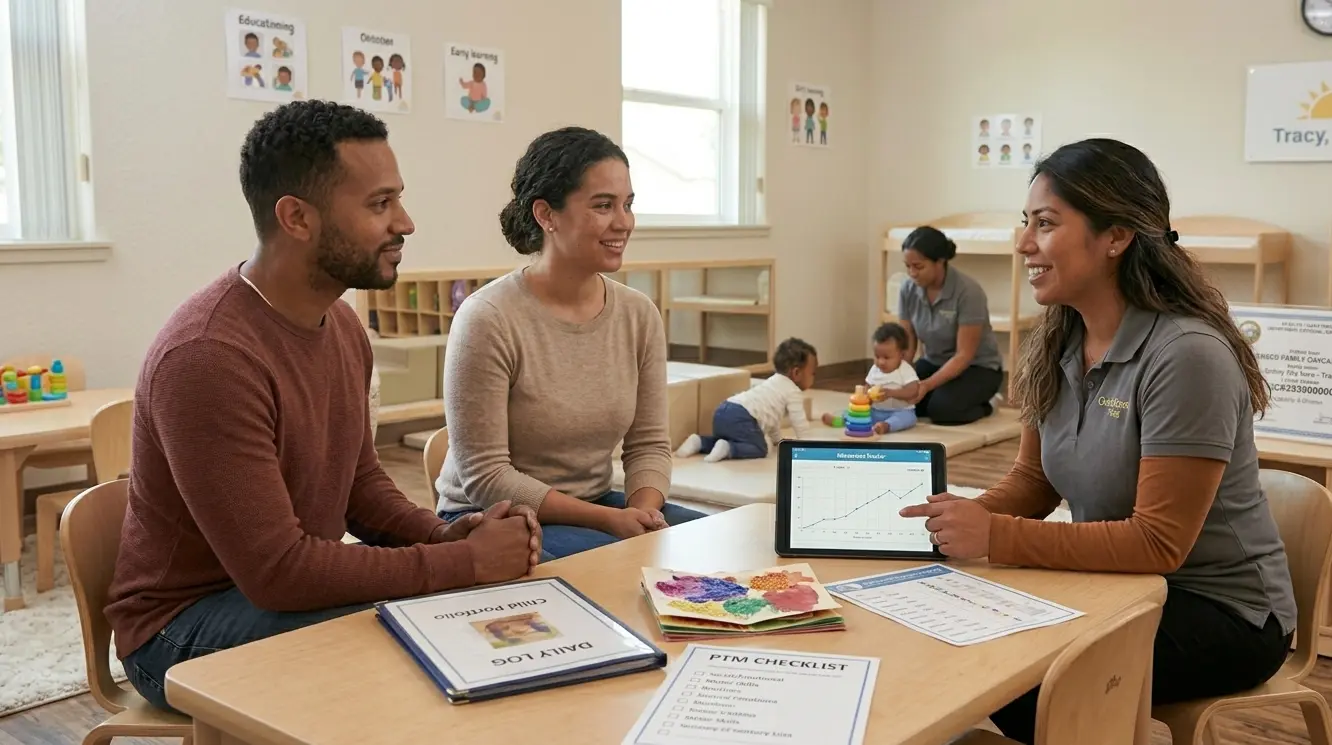
Ask every daycare you tour specifically how they communicate with parents on a daily basis. The strongest programs in Tracy use a combination of digital daily reports sent through a parent communication platform such as Brightwheel, HiMama, or Tadpoles — covering feeding, sleep, diaper changes for infants, and activity summaries for older children — along with real-time photo updates, formal parent-teacher conferences at least twice per year, and an open-door policy that allows parents to call during the day or observe their child’s classroom with reasonable advance notice.
Warning signs to watch for include caregivers who are vague or flustered when you ask how your child’s day went, no structured system for daily written or digital communication, and a director who becomes defensive or evasive when you ask how concerns are raised and resolved. Transparent, proactive communication is one of the most consistent hallmarks of a truly trustworthy childcare program.
Checkpoint 7 — Confirm the Hours and Location Fit Your Real Life
A daycare that is philosophically excellent and beautifully run is still the wrong choice if it adds 40 minutes to your morning commute or closes 30 minutes before you can realistically get there from work. Practical logistics are a legitimate part of this decision, and there is absolutely no reason to feel shallow for weighing them carefully alongside everything else.
When evaluating location and operating hours, consider whether the Tracy daycare sits on or near your regular route to work, or within a comfortable distance from your home in neighborhoods including Tracy Hills, West Tracy, Sienna Park, Harvest Country, Sterling Park, or areas near Grant Line Road. Consider whether the program’s hours — most licensed Tracy centers operate Monday through Friday from 6:00 AM to 6:00 or 6:30 PM — genuinely match your work schedule including your commute. Consider whether part-time enrollment is available if your schedule changes week to week. According to CareLuLu data, approximately 12 daycare programs in Tracy currently offer part-time or drop-in options.
Ask for a written list of closure days before you commit. Some Tracy daycares close for state and federal holidays, professional development days, or other dates that may not align with your employer’s schedule. Getting this information upfront prevents the last-minute scramble for backup childcare that every working parent in Tracy eventually experiences.
Checkpoint 8 — Understand the Full Cost and What Financial Help Is Available
Childcare is one of the largest household expenses for California families. The average cost of full-time daycare in Tracy across both home-based and center programs is approximately $819 per month according to CareLuLu data. Licensed center-based infant care, which carries the highest staffing costs due to ratio requirements, typically ranges from $900 to $1,400 per month in Tracy depending on the program and the age of your child.
Before committing to any program, ask for a complete written breakdown of every cost associated with enrollment. Monthly tuition is only part of the picture. Registration fees, annual materials or activity fees, rate increases built into multi-year enrollment agreements, and late pick-up charges — which many Tracy daycares assess on a per-minute basis after closing time — can add several hundred dollars to your actual annual cost if you are not made aware of them upfront.
Equally important is understanding what financial assistance you may qualify for. The California Child Care Assistance Program, known as CCAP and administered locally through the San Joaquin County Office of Education, provides childcare subsidies to income-eligible families throughout Tracy. The California State Preschool Program provides free or subsidized preschool to eligible children ages 3 to 5. Tracy KinderCare on West Grant Line Road participates in this program in partnership with San Joaquin County. The federal Child and Dependent Care Tax Credit can further reduce your annual childcare costs at tax time. Ask any Tracy daycare whether they accept CCAP subsidies before investing significant time in a full tour and enrollment conversation.
Checkpoint 9 — Match the Program to Your Child’s Individual Needs
Every parent reading this checklist is making this decision for one specific child — theirs. And no two children are the same. The best daycare in Tracy for your neighbor’s family is not automatically the right fit for yours, even if your children are the same age and you live a block apart.
Before you finalize any decision, think carefully and honestly about what your specific child actually needs in a childcare environment.
For infants and very young toddlers, the most important factor is a consistent, responsive primary caregiver who maintains a genuinely low ratio and brings real warmth to each daily interaction. Developmental psychologist John Bowlby’s attachment theory makes clear that young children build the emotional security needed to explore the world through reliable, attuned caregiving. A smaller home-based program or a licensed center with a dedicated primary caregiver model often serves children under 18 months better than a large, busy facility with frequent caregiver transitions.
For children with sensory sensitivities, developmental differences, or diagnosed needs, look specifically for a Tracy daycare that has prior experience serving children with similar profiles and staff trained in differentiated approaches, inclusive care practices, or frameworks like the Pyramid Model for Supporting Social Emotional Competence in Early Childhood.
For highly social, energetic, and curious children, a larger center with structured group activities, outdoor exploration time, and a stimulating curriculum tends to be a wonderful fit and an environment where those children genuinely thrive.
For quieter, more sensitive children who become overwhelmed in large group settings, a smaller program with intentionally intimate classroom sizes will typically produce a much smoother and happier daily experience.
Your child’s temperament is information. Use it when making this decision.
Checkpoint 10 — Trust What You Feel During the Tour
After you have verified licensing, reviewed ratios, asked about curriculum, and compared costs, the in-person tour remains the moment that matters most. It is your opportunity to observe the program running in real time and to pay attention to something that no checklist can fully capture — how the place actually feels when children are in it.
Walk through the facility slowly and without rushing. Notice whether caregivers get down to children’s eye level when they speak with them. Observe whether children look genuinely happy and engaged or restless and overlooked. Watch carefully how a caregiver responds when a child falls, becomes upset, or needs comfort. That single moment of responsiveness — or its absence — tells you more about a program’s culture than anything written in a brochure.
Notice how the director responds to your questions. A director who is genuinely proud of what they have built will answer your questions openly, with specific detail and visible enthusiasm. A director who becomes defensive, dismissive, or evasive when you ask about ratios, staff credentials, turnover rates, or inspection records is telling you something important about how that program operates when parents are not watching.
One parent reviewing a Tracy childcare program on Care.com described interviewing 14 daycares before walking into one where she knew before the tour was over that it was the right choice. That kind of clarity is real and it is possible. It tends to arrive when a program is doing something genuinely right — when the caregivers are engaged, the children are thriving, and the director is someone who has nothing to hide.
The best daycare in Tracy is one where you leave the tour feeling completely at peace about the idea of dropping your child off every morning. If that feeling is not there after a thorough visit, keep looking. The right program exists.
What Tracy Competitors Are Doing — And How Child Daycare Tracy Stands Apart
After studying the daycare landscape in Tracy across platforms including Care.com, CareLuLu, Upwards, Winnie, Wonderschool, KinderCare’s own program pages, and Yelp Tracy parent reviews, several things stand out about how local programs position themselves and what Tracy parents consistently say they value when they describe a great childcare experience.
Tracy KinderCare, located at 265 West Grant Line Road, is the most prominent national chain presence in the city. Its strengths include a nationally structured curriculum backed by significant institutional resources, pursuit of NAEYC and NECPA accreditation, a registered dietician-developed meal and snack program, and an active partnership with San Joaquin County for the California State Preschool Program. Director Eva Prado brings 16 years of early childhood experience to the program. Parents on Yelp frequently mention responsive teachers and consistent daily communication. The limitation for some Tracy families is the larger center format, which can feel less personal than a locally-owned program where staff know every child and family by name.
Tender Loving Care Preschool and Child Care in Tracy is consistently praised in parent reviews for the warmth of its staff and the genuine relationships caregivers build with children and families over time. Year-round operation is a meaningful practical advantage for working families.
Bright Stars Learning receives strong community feedback on Yelp, with multiple parents citing attentive staff, structured daily activities, and the visible happiness of children at afternoon pick-up. The consistency of this feedback across independent reviewers over time suggests a program with a stable and caring team.
Global Village Montessori brings authentic Montessori methodology to the Tracy market, serving families who prioritize child-led exploration, hands-on learning materials, and mixed-age classroom environments.
Lullababy Childcare, a licensed home-based program in Tracy serving up to eight children, offers an intimate ratio and a blended Waldorf, Reggio Emilia, and Montessori philosophy for families who prefer a home setting with a smaller group.
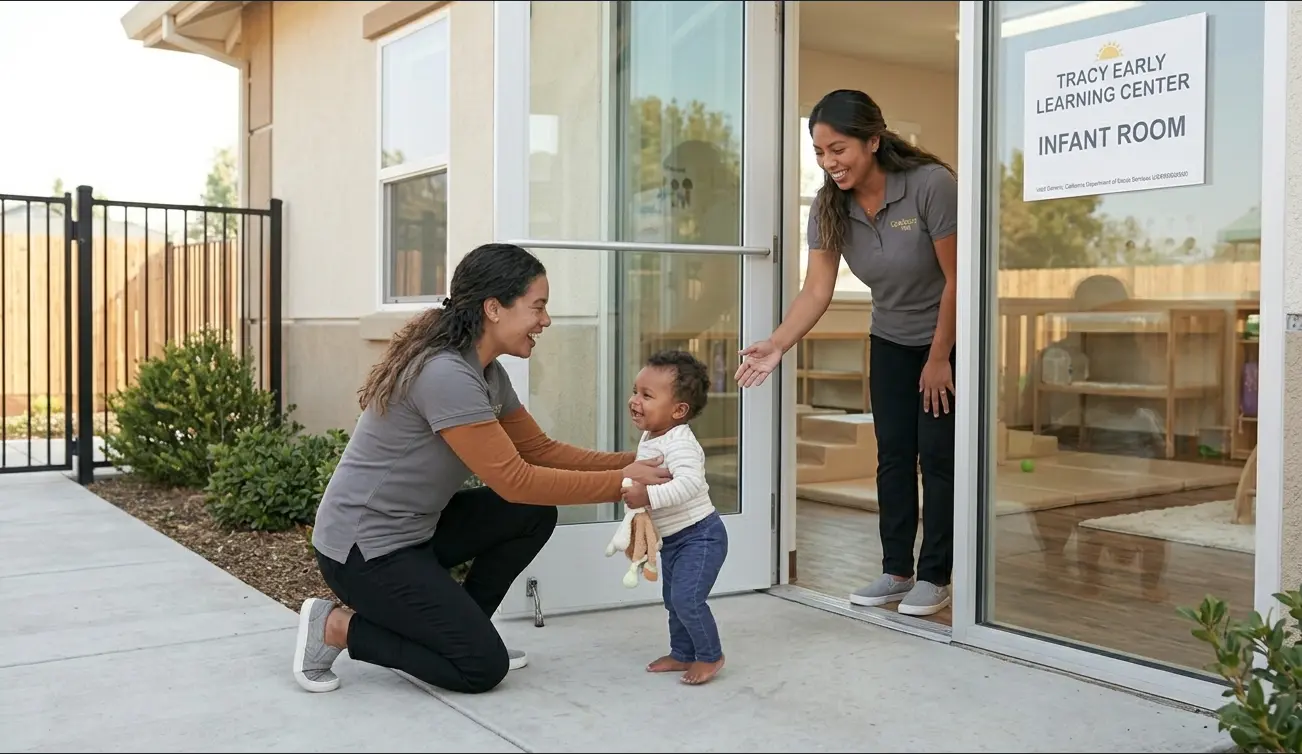
At Child Daycare Tracy, we combine the warmth and personal attention of a locally owned program with the structure of a Montessori-inspired curriculum, a consistently low caregiver-to-child ratio, daily parent communication through a dedicated app, and a full continuum of care from infant and toddler programs through preschool, kindergarten-prep, and after-school offerings. Our caregivers hold California Child Development Permits, maintain current CPR and First Aid certification, and participate in ongoing professional development throughout the year. We serve families throughout Tracy including the 95376 and 95377 zip codes, and we welcome tours year-round.
10 Questions to Ask at Every Tracy Daycare Tour
Bring this list to every visit. Written notes are more reliable than memory, especially when you are touring multiple programs in a short period.
What is your current California state license number and when was your most recent CDSS inspection?
What is the actual caregiver-to-child ratio in your infant and toddler rooms right now, during peak morning hours?
What child development credentials and permits do your lead teachers currently hold?
Can you walk me through a complete daily schedule for my child’s age group?
How do you communicate with parents throughout the day, and what platform do you use?
What is your written policy on illness and at what point are parents called to pick up their child?
How do you support a child who is having a difficult transition or showing signs of separation anxiety?
Do you accept California CCAP childcare subsidies or participate in the California State Preschool Program?
What is the full cost breakdown including registration fees, materials fees, and late pick-up charges?
How long has your longest-serving caregiver been with this program?
Any director worth trusting with your child will welcome every single one of these questions and answer them without hesitation.
Frequently Asked Questions About Choosing a Daycare in Tracy CA
How do I verify a daycare is licensed in Tracy CA? Visit ccld.dss.ca.gov and use the facility search function to enter any Tracy daycare’s name or address. You will see live license status, licensed capacity, the most recent inspection record, and any citations or complaints on file. It is free, public, and takes under five minutes.
What is the average monthly cost of daycare in Tracy CA? Full-time daycare in Tracy averages approximately $819 per month across home-based and center programs combined, based on CareLuLu data. Licensed center-based infant care typically ranges from $900 to $1,400 per month depending on the program.
What financial assistance is available for Tracy CA daycare costs? The California Child Care Assistance Program through the San Joaquin County Office of Education provides income-based subsidies. The California State Preschool Program offers free or reduced-cost preschool for eligible children ages 3 to 5. The federal Child and Dependent Care Tax Credit can offset a meaningful portion of annual childcare costs. Ask any Tracy daycare whether they accept CCAP before enrolling.
How many licensed daycares are there in Tracy CA? Based on CareLuLu data, there are approximately 134 licensed daycare programs in Tracy, including 84 home-based programs and 50 licensed childcare centers. Upwards lists approximately 68 active programs on their Tracy platform.
What caregiver-to-child ratio should I look for at a Tracy daycare? California law sets minimums of 1 caregiver per 3 to 4 infants, 1 per 6 toddlers, and 1 per 12 preschoolers. The best Tracy programs operate below these minimums. Always observe the actual ratio during your tour rather than relying on what the director says alone.
Does Child Daycare Tracy accept CCAP childcare subsidies? Yes. We work with families enrolled in the California Child Care Assistance Program and other state-funded assistance programs. Contact our team directly and we will help you understand eligibility and walk you through the enrollment process.
Ready to Tour the Best Daycare in Tracy CA?
At Child Daycare Tracy, we welcome you to come see our program in person and measure it against every point on this checklist. We are a licensed, professionally staffed, Montessori-inspired childcare center serving Tracy, CA 95376 and 95377 — enrolling children from infancy through kindergarten-prep age.
Schedule your tour today. Your child deserves the very best start, and it begins right here in Tracy, California.