
Most licensed daycare centers in Tracy, CA — including our program at Child Daycare Tracy — accept infants as young as 6 weeks old. However, the right age for your baby depends on several personal factors: your maternity or paternity leave, your child’s developmental readiness, your family’s financial situation, and the quality of the infant program you choose. While 6 weeks is the legal minimum in California, many early childhood development professionals suggest that waiting until at least 3 to 6 months, when a baby’s immune system is stronger and sleep patterns are more established, tends to make the transition smoother for both the child and the parent.
There is no single universal answer. What matters most is finding a nurturing, licensed childcare environment in Tracy where your infant receives one-on-one attention, consistent caregiving, and age-appropriate stimulation — regardless of when you start.
Why This Question Matters More Than You Think
Choosing when to enroll your infant in daycare is one of the biggest decisions you will make as a new parent. For families in Tracy, CA — a growing city in San Joaquin County where many households have two working parents — this question comes up earlier than expected. Most parents start researching infant care options well before their baby is born, and for good reason: quality infant spots at licensed centers fill up fast.
What makes this decision genuinely complicated is that there are real emotional, developmental, and financial variables at play all at once. You are not just picking a schedule — you are thinking about your child’s attachment, their exposure to illness, whether they will thrive in a group setting, and whether you will feel at peace dropping them off each morning. All of that deserves a thoughtful answer.
What California Law Says About Infant Daycare Age
In California, licensed childcare centers are permitted to enroll infants starting at 6 weeks of age. This is governed by Title 22 of the California Code of Regulations, which sets the minimum age and the required caregiver-to-infant ratios for licensed facilities. The California Department of Social Services (CDSS) mandates that a licensed infant care room maintain a ratio of no more than 3 or 4 infants per caregiver, depending on the ages of the children in the room.
This is important for Tracy parents to understand because not every facility follows these ratios strictly, particularly home-based providers. When you visit any Tracy daycare for a tour, ask specifically what the infant-to-caregiver ratio is during peak hours — not just on paper, but in practice.
Age-by-Age Breakdown: What to Expect at Each Stage
Understanding what is happening developmentally at each age stage helps you make a much more informed decision about timing.
Starting Daycare at 6 Weeks
At 6 weeks, your baby has typically received their first round of vaccinations and is beginning to show early signs of alertness and visual focus. They are still almost entirely dependent on responsive, one-on-one caregiving. Their immune systems are immature, their feeding schedules are often unpredictable, and they have not yet formed strong social bonds outside the home.
Starting at this age is usually driven by the end of parental leave rather than the baby’s developmental readiness. If this is your situation, it is not cause for alarm — but it does mean the quality of the infant program matters enormously. Look specifically for a Tracy daycare that assigns your baby a primary caregiver, maintains a very low infant ratio, and communicates daily feeding and sleep records back to you.
Starting Daycare at 3 Months
By 3 months, most babies have stronger head control, smile socially in response to faces, and are beginning to regulate their sleep and feeding cycles more predictably. Many child development professionals point to this window as a more manageable starting point than the 6-week mark.
A baby at 3 months is better equipped to tolerate brief separations. They begin to recognize familiar faces, which means a consistent caregiver at your Tracy daycare center will quickly become a comforting presence. Part-time enrollment at this stage — perhaps 3 days per week — can ease both your baby and yourself into the new routine.
Starting Daycare at 6 Months
Six months is widely cited as one of the more favorable ages to begin infant daycare. At this stage, babies can sit with support, recognize primary caregivers, track objects with their eyes, and respond to their own name. Their immune systems are meaningfully stronger than they were at birth, and their sleep patterns are often more predictable.
The one developmental note worth being aware of at this age is the beginning of separation anxiety, which typically emerges between 6 and 9 months. This is completely normal and does not mean daycare is the wrong choice — it simply means that a consistent, warm drop-off routine at your Tracy childcare center will be especially important.
Starting Daycare at 9 to 12 Months
By 9 months, your baby has a distinctly emerging personality. They are mobile, curious, and increasingly interested in other children. Starting daycare at this age can actually be socially enriching, as babies this age begin engaging in parallel play and respond enthusiastically to stimulating environments.
The tradeoff is that separation anxiety tends to peak in this window. A Tracy daycare with experienced infant teachers who understand how to handle this transition will make an enormous difference. Gradual transitions — spending a short time at the center before full enrollment begins — are particularly helpful at this stage.
Starting Daycare at 12 Months and Beyond
Some Tracy families wait until their child turns one. At 12 months, most babies are pulling up to stand, some are walking, and they are actively exploring everything around them. They respond well to structured early learning environments and benefit significantly from peer interaction.
If you have the flexibility to wait until 12 months, research does suggest that children who receive consistent at-home care through the first year and then transition to high-quality daycare tend to adjust well and show positive developmental outcomes.
Key Factors That Should Guide Your Decision
Beyond developmental age, there are several practical and personal factors that Tracy parents need to weigh carefully.
Your Parental Leave and Work Schedule
California has one of the most generous paid family leave programs in the country. Through the California Paid Family Leave (PFL) program administered by the Employment Development Department (EDD), eligible parents can receive up to 8 weeks of partial pay after the birth of a child. Some employers in Tracy provide additional leave on top of this.
If you can use your full leave before returning to work, you may be able to delay your baby’s daycare start until 2 to 3 months. Planning your enrollment timeline around your return-to-work date — and getting on a waitlist early — is one of the smartest things a Tracy parent can do.
Your Baby’s Individual Temperament
Some infants are naturally adaptable. They settle into new environments quickly, take comfort from multiple caregivers, and show curiosity rather than distress in unfamiliar settings. Others are more sensitive and need longer to adjust.
Neither temperament is better or worse — but knowing your baby helps you choose the right pace for the transition. A professional child daycare in Tracy with experienced infant caregivers will recognize these differences and adjust their approach to each child.
The Quality of the Infant Program
This is arguably the most important factor of all. Research consistently shows that the quality of the childcare environment matters far more than the exact age at which a child starts. A high-quality infant program in Tracy should include:
- A low caregiver-to-infant ratio (no more than 3 to 4 infants per caregiver)
- A licensed facility inspected and approved by the California Department of Social Services
- Caregivers with training in early childhood education or child development
- Safe sleep practices in compliance with the American Academy of Pediatrics (AAP) guidelines
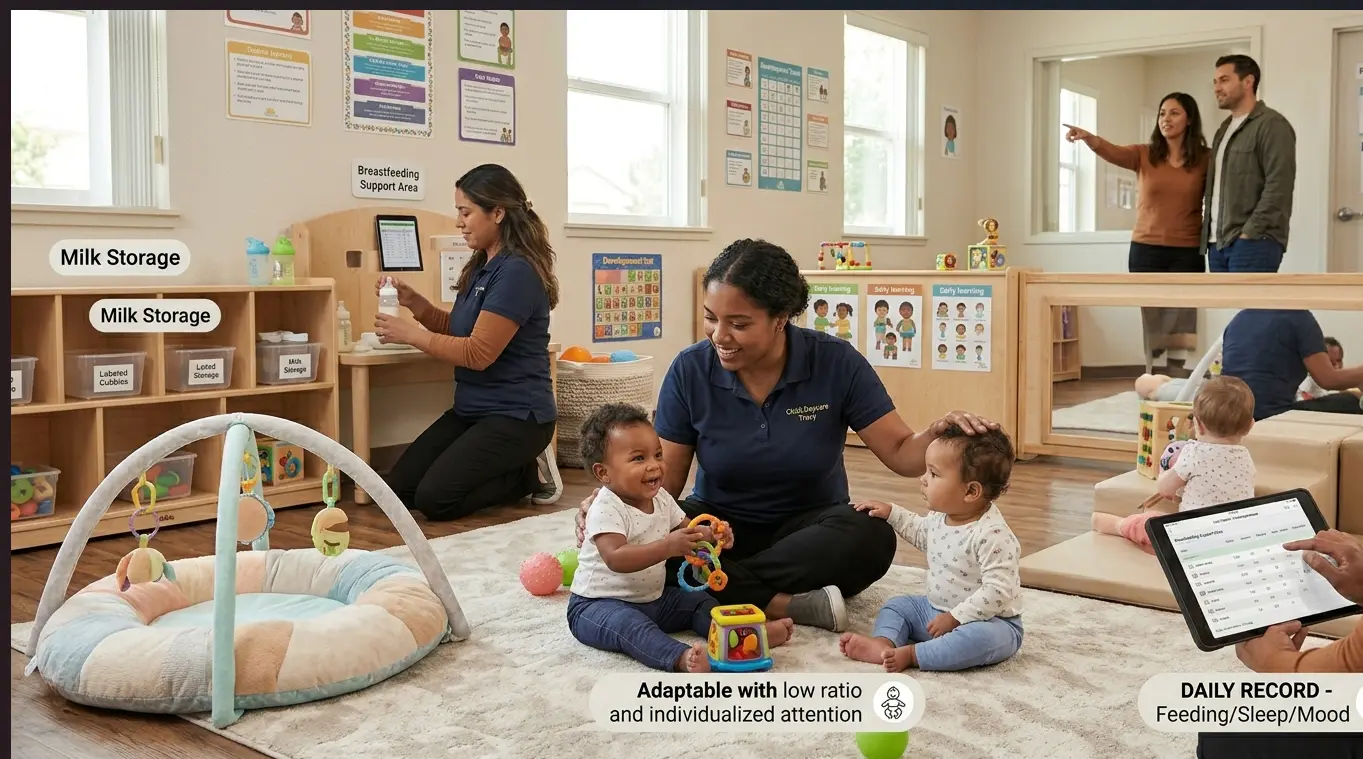
- Daily written or digital communication with parents about feeding, sleep, diaper changes, and mood
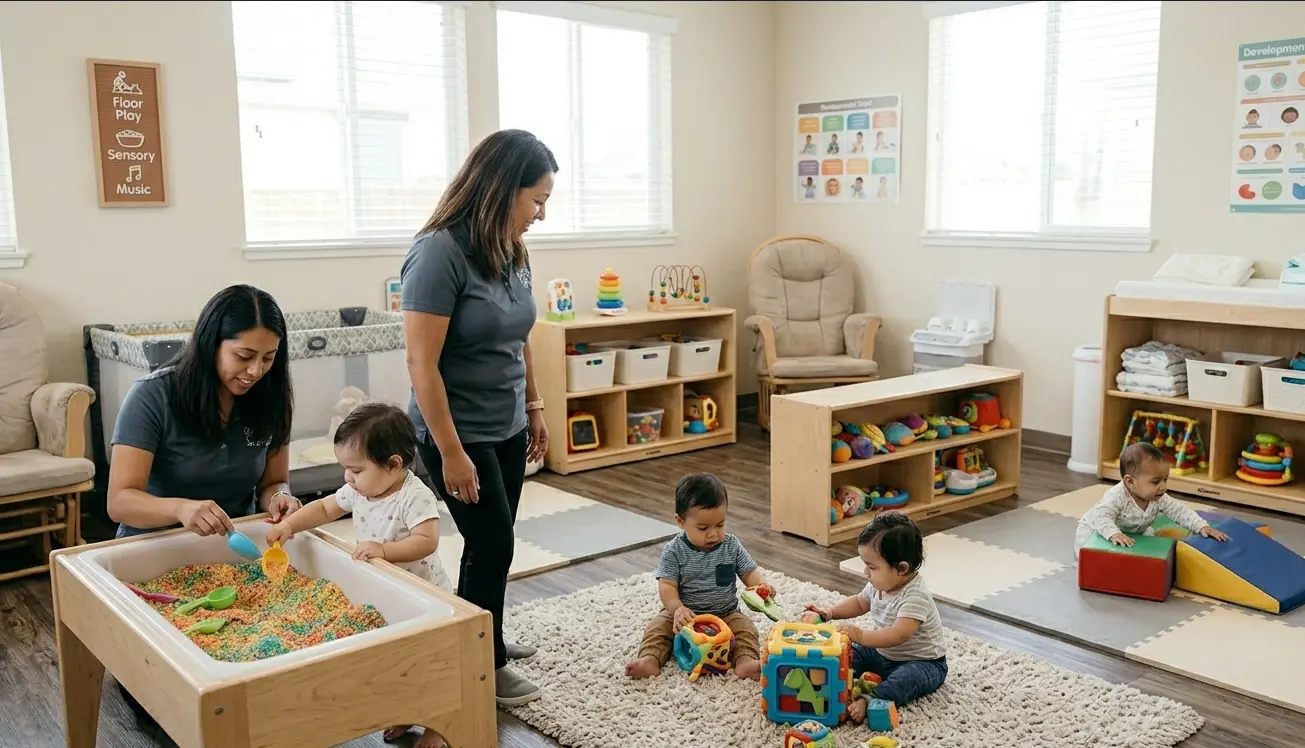
- A nurturing, stimulating environment with age-appropriate sensory activities
When you tour an infant daycare center in Tracy, these are the specific things to observe — not just how clean the facility looks, but how caregivers actually interact with the babies in their care.
Breastfeeding Goals
If you plan to breastfeed, timing your return to work and your baby’s daycare start around your breastfeeding goals is a very real consideration. The AAP recommends exclusive breastfeeding for at least 6 months. A supportive Tracy daycare should have a clear policy for receiving and storing breast milk, warming bottles correctly, and communicating feeding patterns back to you.
What Tracy Competitors Are Doing (And What Sets Us Apart)
After reviewing what competing childcare centers in Tracy currently offer for infant programs, a few things stand out.
Tracy KinderCare on West Grant Line Road accepts infants from 6 weeks and emphasizes structured daily routines and safe sleep practices. Bizzy Beez Academy offers personalized daily infant care records sent home with parents each evening, which is a valuable communication tool. Lullababy Childcare in the Madison neighborhood uses a blend of Waldorf, Reggio Emilia, and Montessori philosophies for infants as young as 3 months.
What most Tracy infant programs share is a focus on ratio, safety, and routine. What differentiates them is the depth of their curriculum philosophy, their communication with parents, and whether they offer continuity of care as your child ages from the infant room into the toddler and preschool rooms.
At Child Daycare Tracy, our infant program begins at 6 weeks and is built around low caregiver ratios, Montessori-inspired sensory activities, and transparent daily communication with families. As your baby grows, they move naturally into our toddler and preschool programs — meaning familiar faces and a consistent learning environment throughout their earliest years.
Signs Your Baby Is Ready for Infant Daycare
Beyond age, look for these readiness indicators before you begin:
Sleep and feeding are somewhat predictable. A baby on a rough schedule is easier for daycare staff to support consistently, which means your baby gets better care.
Your baby shows curiosity about new faces. Babies who make eye contact with strangers and respond to new voices tend to adjust to daycare more comfortably.
You have had a chance to bond securely. Early attachment research, including the foundational work of developmental psychologist John Bowlby, shows that a secure attachment formed in the first weeks of life gives children the emotional foundation to explore new environments with confidence — including daycare.
Your baby has received their initial vaccinations. The 2-month vaccination schedule covers several common illnesses that circulate in group care settings. Waiting until after this milestone provides a meaningful layer of protection.
How to Prepare Your Infant for the Transition
Even when the timing is right, the transition to infant daycare in Tracy takes intentional preparation. Here is what tends to work well.
Start with a gradual schedule. If possible, begin with 2 to 3 days per week for the first few weeks before transitioning to full-time care. This gives your baby time to build familiarity with the new environment and caregivers.
Create a consistent drop-off routine. A predictable goodbye — a hug, a short phrase, a wave — gives your baby a reliable signal that you are leaving and that you will return. Inconsistent or prolonged goodbyes often make the transition harder, not easier.
Bring a comfort object. A small blanket or stuffed animal that smells like home can provide real comfort to an infant in an unfamiliar environment. Check with your Tracy daycare about their policy on personal items in the infant room.
Communicate openly with caregivers. Share your baby’s feeding preferences, sleep cues, soothing techniques, and any health considerations from day one. The more your infant’s daycare team in Tracy knows about your baby, the better they can respond to their needs.
Be patient with yourself. Most parents find the first few drop-offs harder on themselves than on their baby. A good infant daycare in Tracy will send you updates throughout the day — use them.
What Does the Research Actually Say?
The academic conversation around infant daycare timing is nuanced and worth knowing as a parent.
The landmark NICHD Study of Early Child Care, conducted by the National Institute of Child Health and Human Development, followed more than 1,000 children across the United States and found that the quality of childcare was a stronger predictor of child outcomes than the age at which care began. Children in high-quality care settings showed stronger language development, better social skills, and greater school readiness — regardless of when they started.
Additional research published in the Journal of Epidemiology and Community Health found that children attending quality daycare programs showed better behavioral adjustment compared to peers who did not attend structured early care environments.
The takeaway for Tracy parents: if the quality is there, the specific starting age matters less than you might fear.
Frequently Asked Questions About Infant Daycare Age in Tracy CA
What is the youngest age a daycare in Tracy CA can accept an infant? Licensed daycare centers in California can legally enroll infants starting at 6 weeks of age. Most centers in Tracy, including our program, accept babies from 6 weeks.
Is 3 months too young to start daycare? No. While it is on the younger side, 3 months can work well if the program maintains a low infant-to-caregiver ratio and your baby’s feeding and sleep patterns are reasonably established. Many Tracy families begin part-time enrollment around this age.
What is the best age to start daycare for a baby? Most child development professionals point to the 3 to 6 month window as a practical sweet spot — your baby is more immunologically resilient and socially responsive, but still young enough that separation anxiety has not yet peaked.
Will starting daycare early harm my baby’s attachment to me? Research does not support the idea that quality daycare damages parent-child attachment. Secure attachment is built through consistent, responsive parenting at home. A supportive infant daycare in Tracy complements — rather than competes with — your bond with your baby.
How do I get on a waitlist for infant daycare in Tracy? Contact your preferred Tracy daycare center as early as possible — ideally during your second trimester. Infant spots are limited and fill quickly, especially for the 6 weeks to 3 months age range.
Ready to Enroll Your Infant at Child Daycare Tracy?
At Child Daycare Tracy, we welcome infants from 6 weeks of age into a safe, nurturing, and Montessori-inspired environment. Our infant caregivers are trained in early childhood development, maintain a low caregiver ratio, and provide daily updates so you always know how your baby’s day went.
Located in Tracy, CA 95376 and 95377, we serve families throughout the city — from Tracy Hills and West Tracy to neighborhoods near Grant Line Road and beyond.
Schedule a tour today and see firsthand why Tracy families trust us with their youngest children right from the start.