
Every new parent in Tracy asks some version of the same question during those first twelve months: is my baby on track? This guide walks through what pediatricians and the CDC actually look for at each checkpoint, what counts as normal variation, and where San Joaquin County families can turn if something feels off. No vague reassurance, just the real framework doctors use.
One thing worth knowing upfront: milestones describe what most babies, roughly 75%, can do by a certain age. They’re a guide, not a pass-or-fail test. A baby who reaches a skill a few weeks earlier or later than listed here is almost always developing normally.
How Pediatricians Actually Track This
The CDC tracks development across four categories: physical (motor skills), cognitive (thinking and problem-solving), language and communication, and social-emotional growth. Official checkpoints happen at 2, 4, 6, 9, and 12 months, which lines up closely with your baby’s regular well-child visits.
One correction worth making here, since a lot of parenting content still gets this wrong: crawling isn’t actually on the CDC’s current milestone checklist. Plenty of healthy babies skip it entirely and go straight to pulling up and walking. Similarly, walking isn’t a 12-month milestone at all. Most babies are just cruising along furniture at their first birthday, with independent steps typically arriving somewhere between 9 and 18 months.
If your baby was born early, pediatricians use corrected age, chronological age minus the weeks born premature, when comparing against these milestones, typically until around age two.
2-Month Checkpoint
Social-emotional: Calms down when spoken to or picked up, looks at your face, seems happy to see you when you approach
Language/communication: Makes sounds other than crying, reacts to loud sounds
Cognitive: Watches you as you move, looks at a toy for several seconds
Physical/movement: Holds head up when on tummy, moves both arms and both legs, opens hands briefly
4-Month Checkpoint
Social-emotional: Smiles on their own to get your attention, chuckles when you try to make them laugh, looks at you, moves, or makes sounds to get or keep your attention
Language/communication: Makes sounds like “ooo,” “aah,” makes sounds back when you talk to them, turns head toward the sound of your voice
Cognitive: Opens mouth for the breast or bottle if hungry, looks at their hands with interest
Physical/movement: Holds head steady without support during play, brings hands to mouth, pushes up onto elbows during tummy time
6-Month Checkpoint
Social-emotional: Knows familiar people, likes to look at self in a mirror, laughs
Language/communication: Takes turns making sounds with you, blows raspberries, makes squealing noises
Cognitive: Puts things in their mouth to explore, reaches to grab a toy they want, closes lips to show they don’t want more food
Physical/movement: Rolls from tummy to back, pushes up with straight arms during tummy time, leans on hands to support themselves when sitting
9-Month Checkpoint
Social-emotional: Shy or clingy around strangers, has favorite toys, plays peekaboo
Language/communication: Lifts arms to be picked up, makes different sounds like “mamamama” and “babababa,” copies sounds an adult makes
Cognitive: Watches an object fall out of sight, looks for objects when dropped out of view, picks things up between thumb and index finger
Physical/movement: Gets to a sitting position on their own, moves things from one hand to the other, sits without support
12-Month Checkpoint
Social-emotional: Plays games with you like peekaboo and pat-a-cake, cries when a parent leaves
Language/communication: Waves bye-bye, calls a parent “mama” or “dada” or a similar name, understands “no”
Cognitive: Puts something in a container, looks for things they see you hide, bangs two things together
Physical/movement: Pulls up to stand, walks holding onto furniture (cruising), drinks from a cup without a lid held by an adult
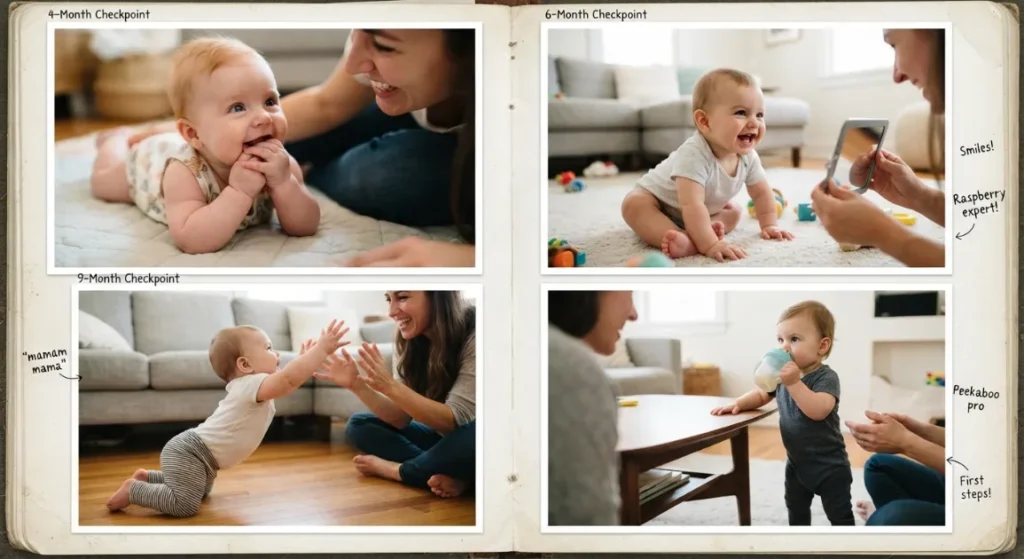
Quick Reference by Checkpoint
| Age | Key Physical Skill | Key Language Skill |
|---|---|---|
| 2 months | Holds head up during tummy time | Makes sounds other than crying |
| 4 months | Pushes up onto elbows | Makes back-and-forth sounds |
| 6 months | Rolls tummy to back | Blows raspberries, squeals |
| 9 months | Sits without support | Copies sounds you make |
| 12 months | Cruises along furniture | Says “mama” or “dada” with meaning |
Why Variation Is Normal, and What Actually Matters
Genetics, birth order, and even personality all play into the timing of any individual skill. A baby who’s a little behind in one category but progressing steadily overall is very different from a baby who’s stalled or losing skills they’d already gained.
What pediatricians actually watch for is the overall trajectory across categories, not whether a single skill lands on an exact date. If you’re weighing whether your baby’s overall readiness lines up with starting group care, our guide on signs your child is ready for daycare breaks down what that actually looks like at the infant stage specifically, since it’s less about hitting milestones and more about routine and provider fit.
When to Talk to Your Pediatrician
Raise these directly at your next well-child visit, or sooner if something feels off:
- No social smiling by 3 months
- No response to loud sounds or your voice by 6 months
- Not sitting with support by 9 months
- No babbling or vocal sounds by 9 months
- Loss of a previously mastered skill, at any age
Bringing up a concern early doesn’t mean something is wrong. The American Academy of Pediatrics recommends formal developmental screening at 9, 18, and 30 months regardless of whether a parent has specific concerns, precisely because early identification makes the biggest difference when support is actually needed.
Local San Joaquin County Resources
If a screening does raise concerns, Tracy families don’t have to navigate this alone. First 5 San Joaquin funds developmental screening and referral services for children birth to five across the county, and Valley Mountain Regional Center coordinates California’s Early Start program locally, which provides evaluation and intervention services for infants and toddlers showing developmental delays. Your pediatrician can also refer you directly if a screening at a well-child visit raises any concerns.
How Quality Infant Care Supports Healthy Development
A responsive, individualized infant care setting plays a real role in supporting these milestones day to day. Rather than a rigid group schedule, quality infant caregivers follow each baby’s individual feeding, sleep, and developmental rhythm, which mirrors exactly what pediatric research points to as ideal for healthy attachment during this stage.
Trained caregivers also build milestone-supporting activities directly into the day: tummy time, sensory exploration, responsive talking and narration, and consistent one-on-one interaction. This is one of the biggest differences between a program that’s simply supervising infants and one that’s actively supporting development.
Want to see exactly how this plays out in a real classroom? Contact us and we’ll walk you through how our infant caregivers track and support development day to day, before you ever need to make a decision.
As Your Baby Approaches the Toddler Stage
The first birthday is really a transition point, not an endpoint. Many of the skills your baby is building toward at 12 months, cruising, early words, object exploration, become the foundation for the next stage of rapid growth. If you’re already thinking ahead, our companion guide on toddler development milestones from 1 to 2 years picks up exactly where this one leaves off.
And if you’re currently comparing infant care providers in Tracy and want a structured way to evaluate them, our Daycare Tour Checklist walks through exactly what to ask, including questions specific to infant caregiving and ratios.
The Bottom Line
The first year brings enormous, fast-moving change, and it’s completely normal to watch closely for every new skill. Use the checkpoints above as a framework, not a scorecard. Stay in regular contact with your pediatrician, lean on San Joaquin County’s local screening and intervention resources if anything feels off, and remember that consistent, responsive care, whether from you at home or a quality caregiver, is what actually drives healthy development at this stage.
Frequently Asked Questions
What are the most important infant milestones in the first year?
Key checkpoints happen at 2, 4, 6, 9, and 12 months, covering physical, language, cognitive, and social-emotional growth. By 12 months, most babies are cruising along furniture, saying “mama” or “dada” with meaning, and playing simple games like peekaboo.
Is it normal for babies to skip crawling?
Yes, crawling isn’t actually on the CDC’s current milestone checklist, and many healthy babies skip it entirely, moving straight to pulling up and walking instead. What matters more is whether a baby is progressing in mobility overall, not the specific sequence they use to get there.
When should I be concerned about my baby’s development in Tracy?
Talk to your pediatrician if your baby isn’t smiling socially by 3 months, isn’t sitting with support by 9 months, or shows no babbling by 9 months. San Joaquin County families can also access developmental screening directly through First 5 San Joaquin or a referral to Valley Mountain Regional Center’s Early Start program.
Does walking happen at 12 months?
No, walking is commonly misunderstood as a 12-month milestone, but most babies are only cruising along furniture at that age. Independent first steps typically arrive somewhere between 9 and 18 months, and this range is considered completely normal.
How can daycare support infant development milestones?
Quality infant care supports development through responsive, individualized routines around feeding and sleep, along with intentional activities like tummy time and sensory play built directly into the daily schedule. Consistent, warm caregiver interaction throughout the day reinforces the same categories pediatricians track at home.