
The night before a child’s first day of daycare is rarely peaceful for the parent, even when the child sleeps just fine. You’ve done the research, toured the facility, checked the licensing, and made the decision. Now it comes down to one morning, one drop-off, and a whole day of wondering how it’s actually going. Here’s what that first day genuinely looks like, what to say in the moments that matter most, and the well-meaning mistakes that tend to make the transition harder rather than easier.
What Actually Happens on Day One
Most parents picture the worst version of day one: prolonged crying, a clingy child, a guilty walk back to the car. Sometimes that happens. Often it doesn’t. Understanding the realistic range helps you walk in with the right expectations instead of catastrophizing before you’ve even arrived.
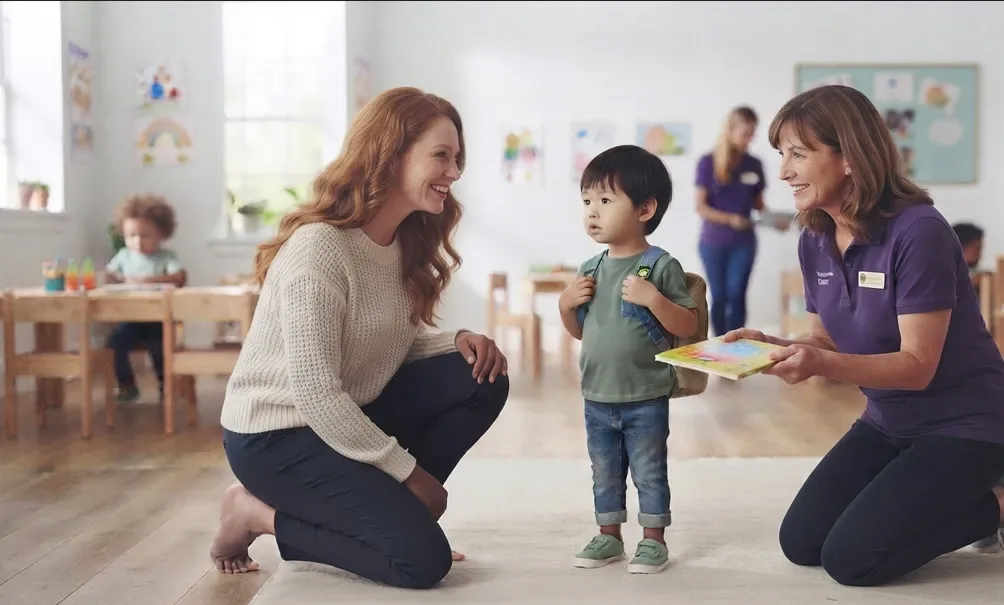
Somewhere between a smooth, tear-free drop-off and an hour of inconsolable crying, most first days land in the middle. A few minutes of protest, a caregiver stepping in to redirect attention, and a child who’s playing normally within fifteen to twenty minutes after you leave. That middle ground is the actual norm, not the exception.
Caregivers experienced with new enrollments have seen this pattern hundreds of times, and most quality providers have a specific approach for easing a first-day transition rather than treating it like any other drop-off.

Before You Even Arrive: What to Prepare the Night Before
A smoother first day starts well before you walk through the door.
- Pack the bag the night before, not the morning of, so the morning itself isn’t rushed
- Label everything, including bottles, clothing, and any comfort item, since first days are chaotic for staff too and unlabeled items get misplaced
- Confirm exactly what the provider needs on day one, such as a change of clothes, diapers, or a specific feeding schedule for infants
- If your child has any allergies or medical needs, confirm the provider has this documented and understood before day one, not verbally mentioned in passing during drop-off
- Get a full night of sleep yourself. An exhausted, anxious parent tends to transmit that anxiety to their child during drop-off, even unintentionally
A Simple First-Day Packing Checklist
| Item | Notes |
|---|---|
| Labeled bag or backpack | Include a change of clothes appropriate for the season |
| Comfort item | Confirm with the provider it’s allowed, common for toddlers |
| Feeding supplies | Bottles, formula, or specific snack preferences for infants and toddlers |
| Diapers and wipes | Even if potty training, pack extras just in case |
| Emergency contact card | Confirm your provider has current numbers, not just what was on the enrollment form |
| Any medication | With written authorization if required by the provider |
What to Say During Drop-Off
The words you use in these two or three minutes matter more than most parents realize, and a few small phrasing choices can make a meaningful difference in how your child processes the moment.
Do say:
- “I’ll be back after nap time” or “I’ll see you after lunch,” giving a concrete, understandable time reference rather than an abstract “later”
- “You’re going to have so much fun with the other kids today”
- “I love you, and I’ll see you soon”
Avoid saying:
- “Don’t cry” or “Don’t be sad,” which can unintentionally signal that their feelings are wrong rather than normal
- Long, drawn-out goodbyes with repeated hugs, which tend to prolong distress rather than ease it
- Sneaking out without saying goodbye at all, which can damage trust once your child realizes you left without telling them
A short, warm, confident goodbye almost always works better than a long, emotional one. Children pick up on parental anxiety immediately, and a hesitant or drawn-out goodbye often signals to them that something is wrong, even when nothing is.
What Not to Do on the First Day
A few common instincts, while completely understandable, tend to make the transition harder rather than easier.
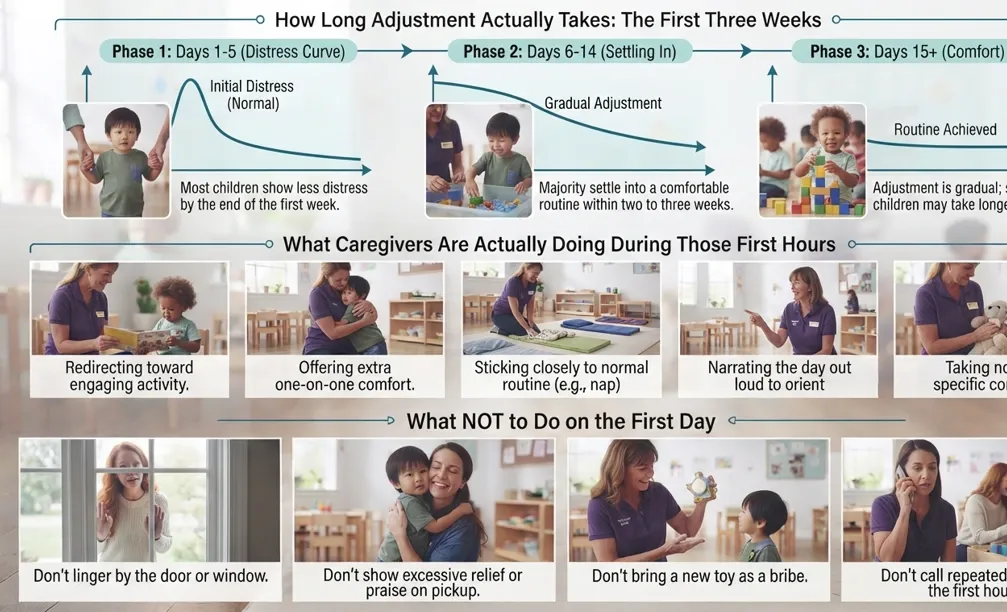
- Don’t linger by the door or window after leaving. If your child sees you watching from outside, it resets any progress the caregiver made calming them down.
- Don’t call the provider repeatedly for updates within the first hour. Give the caregiver time to actually settle your child before checking in. Most quality providers will proactively reach out if there’s a real concern.
- Don’t promise something you can’t guarantee, like “I’ll pick you up in one hour” if you’re actually working a full day. Broken promises on day one damage trust for future drop-offs.
- Don’t bring a new toy or treat specifically as a bribe to get them through the door. This can create an expectation that drop-off requires a reward every time going forward.
- Don’t show visible relief or excessive praise the moment you pick them up, like an exaggerated “Oh thank goodness you survived!” Children pick up on that tone and may interpret it as confirmation the day was something to survive rather than enjoy.
What Caregivers Are Actually Doing During Those First Hours
Understanding what happens on the other side of that door can ease a lot of parental anxiety. Experienced caregivers typically use a specific set of strategies during a child’s first day, particularly in a well-run toddler program or infant care setting.
- Redirecting attention toward an engaging activity within the first few minutes after a parent leaves
- Offering extra one-on-one attention and physical comfort if a child is distressed
- Sticking closely to the child’s normal routine as much as possible, especially around nap and feeding times
- Narrating the day out loud to help an anxious child feel oriented, such as “First we’re going to have snack, then we’ll go outside”
- Taking note of specific triggers or comforts, like a particular song or object that helps a child settle, for future reference
A provider who can describe this kind of specific, practiced approach during your enrollment conversation, rather than a vague “they’ll be fine,” is showing you they’ve handled this transition many times before.
How Long Adjustment Actually Takes
Parents often expect either instant comfort or ongoing distress, when the reality is usually a gradual curve.
Most children show noticeably less distress by the end of the first week, and the majority settle into a comfortable routine within two to three weeks. Some children, particularly those with more cautious temperaments, may take slightly longer, and that’s not necessarily a sign anything is wrong.
If distress hasn’t eased at all after three to four weeks, with no signs of improvement even during pickup or through caregiver reports, that’s worth a direct conversation with the provider about whether adjustments to the routine, or a longer transition period, might help.
What to Ask at Pickup on Day One
The questions you ask at pickup shape how much useful information you actually get, beyond a generic “how was your day.”
Try asking:
- “What did they eat, and how much?”
- “Did they nap, and for how long?”
- “What activity did they seem to enjoy most?”
- “How long did it take them to settle after I left?”
- “Is there anything I should know for tomorrow?”
Specific questions tend to get specific answers, which gives you a much clearer picture than a general “they did great.”
Handling Your Own Emotions as a Parent
This section rarely gets covered, but it matters just as much as anything happening with your child. Guilt, anxiety, and second-guessing your decision are all completely normal reactions to a first daycare drop-off, even when you’ve done all the right research and chosen a genuinely excellent provider.
It’s worth remembering that a hard first day for you doesn’t necessarily reflect a hard first day for your child. Many parents report far more anxiety walking away than their child actually experienced once inside, once they get an honest report at pickup.
If you find yourself unable to shake persistent worry throughout the day, it can help to schedule something engaging or distracting for those first few hours rather than sitting and waiting for the clock to move.
Setting Up Day Two and Beyond for Success
The second and third days often go smoother simply because both you and your child now know what to expect. A few things that help maintain momentum:
- Keep the same drop-off routine and phrasing each day, since consistency builds familiarity faster than novelty does
- Avoid making drop-off longer on subsequent days just because day one felt hard, since a longer goodbye typically increases distress rather than reducing it
- Continue asking specific pickup questions daily for at least the first two weeks, since patterns become clearer over time
- If a comfort item was allowed and helped on day one, continue it consistently rather than only using it occasionally
When to Be Concerned Versus When It’s Normal
It helps to know the difference between typical adjustment behavior and something that might need more attention.
Generally normal:
- Crying at drop-off that eases within 10 to 20 minutes
- Some clinginess at pickup for the first week or two
- Minor changes in appetite or sleep during the adjustment period
- Regression in a recently learned skill, like potty training, for a short window
Worth a conversation with your provider or pediatrician:
- Distress that doesn’t ease at all, even after several weeks, with no improvement reported by staff
- Signs of persistent fear specifically tied to the provider or facility, beyond typical separation anxiety
- Physical symptoms like ongoing appetite loss or sleep disruption extending well beyond the first month
If you’re unsure whether your child was ready for this transition in the first place, our guide on signs your child is ready for daycare covers the broader readiness picture in more depth.
How the Right Provider Makes This Easier
A lot of how smoothly day one goes comes down to the provider’s actual experience with transitions, not just facility quality. This is one of the reasons we cover transition support specifically in our guide on the signs of a high-quality daycare center, and it’s worth revisiting that list if you haven’t finalized your provider choice yet.
If you’re still comparing options broadly, our complete guide to choosing daycare in Tracy and our breakdown of questions to ask during your daycare tour both help you evaluate transition support directly during the decision-making process, before you’re standing at the door on day one.
What the Research Says About Separation and Adjustment
According to guidance from the American Academy of Pediatrics, separation anxiety is a normal developmental stage rather than a sign of poor readiness, and consistent, predictable routines during drop-off tend to ease this adjustment faster than either avoiding goodbyes or prolonging them. Early childhood researchers consistently find that caregiver responsiveness during this window, meeting distress with comfort rather than dismissal, plays a larger role in adjustment speed than the specific facility environment itself.
The Bottom Line for Day One
A hard first day doesn’t predict a hard month, and a smooth first day doesn’t guarantee no bumps ahead. What matters most is a short, confident goodbye, a provider experienced enough to handle the transition without you in the room, and specific enough communication at pickup that you actually know how the day went rather than guessing.
If you have questions about how our own first-day process works before enrolling, contact us directly. We’re happy to walk you through exactly what to expect before you’re standing at the door yourself.
Frequently Asked Questions
Is it normal for a child to cry on their first day of daycare?
Yes, this is one of the most common and developmentally normal reactions to a new environment and separation from a parent. Most children settle within 10 to 20 minutes after a parent leaves, even if the goodbye itself was difficult.
How long does it take a child to adjust to daycare?
Most children show noticeable improvement within the first week and settle into a comfortable routine within two to three weeks. Some children, particularly more cautious temperaments, may take slightly longer without it being a sign of a problem.
Should I stay and watch my child from outside after drop-off?
No, lingering or watching from a window or doorway after leaving typically resets any progress a caregiver has made calming your child. A short, confident goodbye followed by fully leaving tends to work better than staying nearby.
What should I ask my daycare provider at pickup on the first day?
Ask specific questions like what they ate, how long they napped, what activity they enjoyed most, and how long it took them to settle after you left. Specific questions tend to produce far more useful answers than a general “how was your day.”