
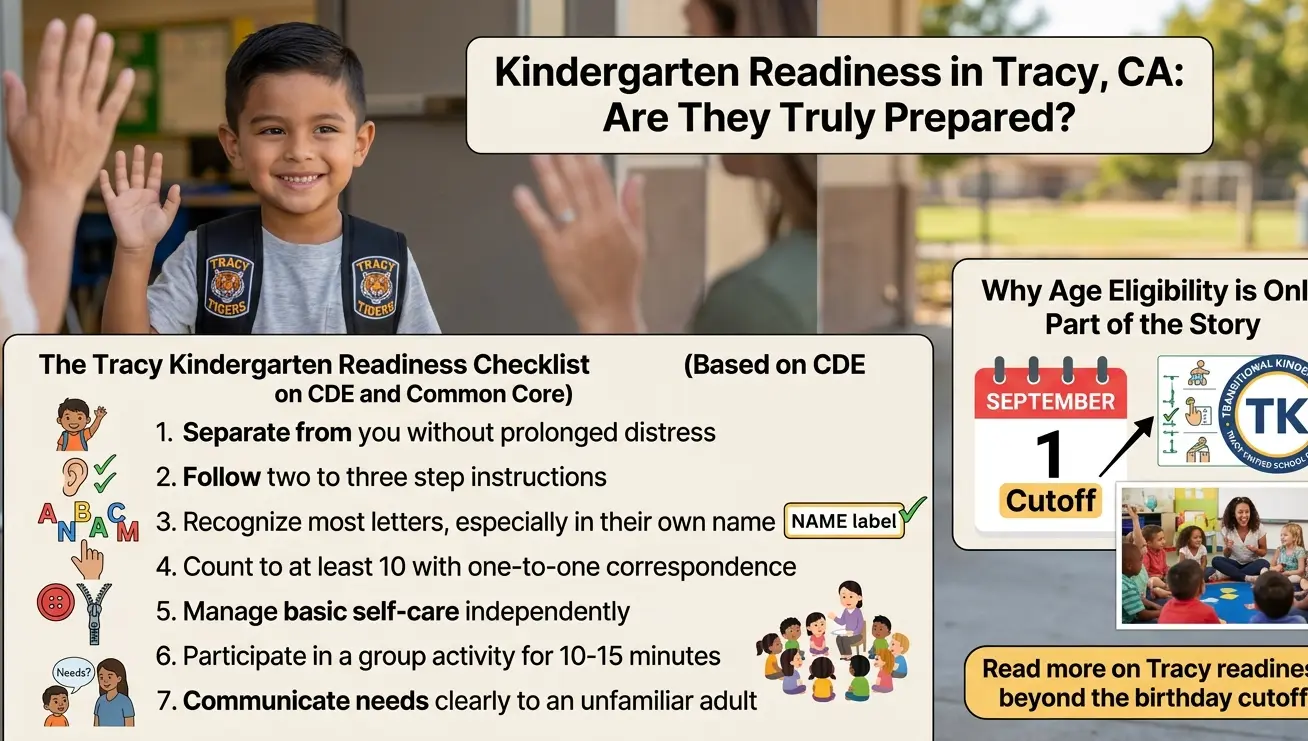
Your child is ready for kindergarten in Tracy, CA if they can separate from you without prolonged distress, follow two to three step instructions, recognize most letters of the alphabet especially in their own name, count to at least 10 with one-to-one correspondence, manage basic self-care independently, participate in a group activity for 10 to 15 minutes, and communicate their needs clearly to an unfamiliar adult. California requires children to turn 5 years old on or before September 1 to enroll in kindergarten at Tracy Unified School District schools. Meeting that age cutoff is required. Actually being ready is a different and more important question.
This checklist is not designed to make you anxious. It is designed to give you an honest and clear picture of where your child stands today, what they genuinely need before that first day of kindergarten, and how to fill any gaps with confidence before enrollment. Every item on this list reflects what kindergarten teachers in Tracy and across California actually expect children to walk in knowing, based on the California Kindergarten Common Core State Standards and the California Department of Education’s own guidance on kindergarten readiness.
Why Kindergarten Readiness in Tracy Is More Than an Age Question
Many Tracy parents assume that turning 5 before September 1 is the only real question when it comes to kindergarten enrollment. The California Department of Education is clear that age eligibility and genuine readiness are two separate considerations. A child can be legally eligible for kindergarten and still benefit enormously from one additional year or kindergarten-prep program.
The Tracy Unified School District philosophy on Transitional Kindergarten reflects this directly. TUSD‘s TK program is designed to meet the academic, social, emotional, and physical needs of children who are approaching kindergarten but benefit from a structured bridge year before formal kindergarten begins. TK in Tracy is not remedial. It is intentional preparation, and many of the most prepared kindergarteners in Tracy Unified elementary schools are children who went through TK before starting formal kindergarten.
Understanding where your child genuinely stands across five developmental domains, which are academic skills, social skills, emotional regulation, physical development, and self-care independence, gives you far more useful information than their birth date alone. This checklist covers all five.
Academic Readiness: What Your Child Should Know Before Kindergarten
Academic readiness does not mean your child needs to be reading chapter books before they walk through the kindergarten door. It means they have the foundational skills that kindergarten instruction builds on directly. Without these foundations, children spend the first weeks of school catching up rather than moving forward.
Literacy and Language Skills
Your child should recognize most or all of the 26 letters of the alphabet, both uppercase and lowercase. By the first day of kindergarten most teachers recommend that children recognize the letters of the alphabet as a foundation for the reading instruction that begins immediately.
Your child should know the sounds that most common letters make. This is called phonological awareness and it is the direct foundation for the phonics instruction that happens in kindergarten. Activities like rhyming games, singing the alphabet, and pointing to letters in books all build this skill naturally during the preschool years.
Your child should be able to recognize their own first and last name in print and attempt to write it. Even if the letters are not perfectly formed, the attempt to write their name demonstrates print awareness and fine motor readiness.
Your child should enjoy being read to and can follow along with a simple story, answer basic comprehension questions like what happened next or who is in the story, and handle a book correctly including holding it right side up and turning pages from front to back.
Your child should be able to communicate clearly in complete sentences, express their needs and feelings verbally to an unfamiliar adult, and follow a multi-step verbal instruction without needing it repeated multiple times.
Math and Number Skills
Your child should be able to count from 1 to at least 20 verbally. More importantly they should demonstrate one-to-one correspondence, meaning they can point to and count individual objects accurately rather than just reciting numbers by memory.
Your child should recognize and name basic shapes including circle, square, triangle, and rectangle. They should identify basic colors reliably. They should be beginning to understand simple patterns and can identify what comes next in a simple pattern sequence.
Your child should have a basic sense of quantity and comparison, understanding concepts like more and less, bigger and smaller, first and last. These concepts are the foundation for the mathematical thinking that kindergarten instruction develops formally.
Early Writing and Fine Motor Skills
Your child should be able to hold a pencil or crayon with a functional grip, color within broad boundaries, draw a recognizable person with at least a head and body, cut along a straight line with child scissors, and attempt to write some letters especially those in their name.
Fine motor skills develop through the kinds of hands-on activities that quality preschool programs in Tracy intentionally build into their curriculum every day. Art projects, playdough, building blocks, threading beads, and using scissors all build the hand strength and coordination that writing in kindergarten requires.
Social Readiness: Can Your Child Work and Play With Others
Social readiness is what kindergarten teachers most consistently identify as the area where children who struggle are most challenged. Academic gaps can be addressed with targeted instruction. Social readiness gaps affect every single hour of every single school day.
Playing Cooperatively With Peers
Your child should be able to play with other children without constant adult intervention. This does not mean conflict never happens. It means your child has some tools for navigating disagreement, can share materials with reasonable consistency, can take turns during games and activities, and shows genuine interest in other children as play partners rather than obstacles.
The developmental psychologist Lev Vygotsky demonstrated through his foundational research that children learn most effectively through social interaction with peers and supportive adults. The cooperative play skills built in a quality preschool environment in Tracy are not separate from learning. They are the social infrastructure through which learning happens.
Following Classroom Instructions and Group Routines
Your child should be able to follow two to three step instructions from an adult they do not know well. They should be able to sit in a group for 10 to 15 minutes during a structured activity like circle time or a read-aloud. They should be able to transition between activities when directed without significant resistance or distress.
These skills sound simple but they represent months of practice in a structured preschool environment. Children who have been in a quality Tracy preschool program where consistent daily routines are practiced have typically developed these skills naturally by the time they approach kindergarten age.
Communicating With Adults Outside the Family
Your child should be comfortable approaching an unfamiliar adult, making eye contact, and communicating a need or question clearly. In kindergarten your child will need to ask to use the bathroom, tell a teacher they feel unwell, and ask for help with an activity independently. Children who have only practiced these communication skills with parents and family members often find this genuinely difficult in a classroom setting with a new teacher and 20 unfamiliar classmates.

Emotional Readiness: The Skills Most Parents Underestimate
Emotional readiness is the area of kindergarten preparation that receives the least attention in parent conversations and the most attention from kindergarten teachers. A child who can read simple words but cannot manage frustration or separate from their parent without a prolonged meltdown will have a significantly harder kindergarten experience than a child with fewer academic skills and stronger emotional regulation.
Managing Frustration Without Falling Apart
Your child should be developing the ability to tolerate frustration without completely losing control. This does not mean your child never gets frustrated or upset. It means they have some capacity to pause, ask for help, or try again when something is difficult rather than immediately escalating to a full emotional crisis.
Developmental neuroscientist Bruce Perry has documented extensively that the brain’s capacity for learning shuts down under significant emotional stress. A child who cannot regulate frustration in kindergarten is a child who cannot learn during the moments when regulation breaks down. Building this capacity is one of the most important things a quality preschool program in Tracy does through intentional social-emotional learning embedded in daily routines.
Separating From Parents Without Prolonged Distress
Your child should be able to separate from you at drop-off and settle into the classroom environment within a reasonable time. Brief upset at separation is completely normal even for children who are genuinely ready for kindergarten. What matters is the recovery. A child who cries for two or three minutes and then engages with the classroom is demonstrating readiness. A child who is inconsolable for the first hour every day for weeks is telling you something important about their current readiness level.
If your child currently struggles significantly with separation, one additional year in a loving, consistent preschool environment at Child Daycare Tracy can make an enormous difference. The gradual, supported separations that happen in preschool are the practice ground for the more independent separation that kindergarten requires.
Adapting to New Situations and New People
Your child should show some capacity to adjust to new environments, new adults, and new routines without extreme distress. Kindergarten brings a new school building, a new teacher, new classmates, a new daily schedule, new rules, and new expectations all at once. Children who have had varied social experiences in preschool and who have practiced adapting to new situations with support are far better equipped for this transition than children who have had no experience outside the family home.
Expressing Feelings in Words
Your child should be developing the ability to say I am angry, I feel sad, or I need help rather than only expressing difficult emotions through behavior. This skill is central to the social-emotional learning frameworks used in California kindergartens including the Collaborative for Academic, Social, and Emotional Learning standards and the Pyramid Model for Supporting Social Emotional Competence in Early Childhood that many Tracy preschool programs including ours incorporate into daily curriculum.
Physical Readiness: Gross and Fine Motor Skills for Kindergarten
Physical development is sometimes overlooked in kindergarten readiness conversations but it matters directly for classroom success. A child who cannot manage basic physical tasks independently creates daily challenges for both the child and the teacher.
Gross Motor Skills
Your child should be able to run, jump, hop on one foot, climb playground equipment, throw and catch a large ball, and navigate stairs with alternating feet. These gross motor skills indicate healthy physical development and are necessary for the daily physical education activities and outdoor play that are part of every kindergarten day.
Fine Motor Skills
Fine motor readiness matters enormously in kindergarten because writing, cutting, drawing, and using classroom manipulatives are central to the daily curriculum. Your child should be able to hold a pencil with a three-finger grip, cut along a line with scissors, draw recognizable shapes and simple pictures, turn pages in a book individually, and manipulate small objects like buttons and blocks with reasonable control.
If your child’s fine motor skills feel behind where they should be, the most effective interventions are daily play with playdough and clay, drawing and coloring activities, simple craft projects involving cutting and gluing, building with small LEGO bricks or similar manipulatives, and threading large beads on a string. These activities directly build the hand strength and coordination that kindergarten writing demands.
Self-Care Independence: The Practical Skills Kindergarten Requires
This is the section that many parents forget entirely until the week before school starts. Kindergarten teachers in Tracy and across California cannot dedicate individual attention to basic self-care needs for every child in a classroom of 20 to 24 students. Your child needs to be able to manage these things independently.
Bathroom Independence
Your child must be able to recognize when they need to use the bathroom and communicate that need to a teacher before it becomes an emergency, manage clothing independently including pants, buttons, and zippers with reasonable competence, wipe thoroughly, flush, and wash hands with soap without requiring adult direction through each step.
This is a practical non-negotiable for kindergarten enrollment. If your child is still regularly having accidents or requiring significant adult assistance in the bathroom, addressing this before kindergarten starts will save a significant amount of daily stress for everyone involved.
Managing Personal Belongings
Your child should be able to put on and take off their own shoes including basic velcro closures at minimum and ideally simple buckles, put on and zip or button their own jacket with minimal assistance, open and close their own backpack, open their own lunchbox and food containers, and keep track of their own belongings during transitions.
Mealtime Independence
Your child should be able to open their own food containers, use basic utensils without spilling constantly, eat their lunch within the 20 to 25 minute lunch period typical at Tracy Unified elementary schools, and clean up after themselves at the table.
Practice these skills at home in the months before kindergarten starts. Many children who are academically ready for kindergarten trip up on exactly these practical independence skills because parents have been doing them for their children out of habit and speed rather than teaching them.

What Tracy Unified School District Requires for Kindergarten Enrollment
Beyond developmental readiness, there are specific documents and requirements for kindergarten enrollment in Tracy Unified School District that every Tracy parent needs to know.
The age cutoff in California is September 1. Your child must turn 5 years old on or before September 1 of the year they are enrolling in kindergarten per California Education Code Section 48000. This applies to all Tracy Unified elementary schools.
Online enrollment for the 2026 to 2027 school year in Tracy Unified opens after March 1. After completing the online enrollment form you must print it, sign the last page, and bring it with supporting documents to your zoned elementary school.
Required documents for Tracy Unified kindergarten enrollment include your child’s original birth certificate or certified copy, current immunization records meeting California state immunization requirements under Health and Safety Code Section 120335, proof of California residency such as a current mortgage statement, rental agreement, or property tax bill with your legal name and address, a recent utility bill from PG&E or City of Tracy dated within the last 30 days, a completed TUSD Student Residency Questionnaire and Affidavit, and a dental oral health assessment completed by a licensed dentist which is required for kindergarten, TK, and first grade in California.
Children whose birthdays fall after September 1 are eligible for Transitional Kindergarten through Tracy Unified in the year before formal kindergarten. TK in TUSD is designed to provide a safe, healthy, and nurturing environment that builds social, emotional, academic, and physical readiness through an age-appropriate modified kindergarten curriculum aligned with California Preschool Learning Foundations.
Contact your neighborhood Tracy Unified elementary school directly or the TUSD enrollment office for school-specific timelines, enrollment appointments, and any additional requirements. Incomplete enrollment packets are not accepted so gathering all documents before your scheduled appointment saves significant time.
What to Do If Your Child Is Not Fully Ready Yet
If you went through this checklist and identified areas where your child is not yet ready, the most important thing is to not panic and not rush the decision. An additional year in a high-quality preschool or kindergarten-prep program in Tracy is one of the best investments you can make in your child’s long-term educational success.
Research published in the journal Child Development consistently shows that children who begin kindergarten genuinely ready outperform peers who were enrolled early throughout their entire elementary school career. The advantage of genuine readiness compounds over time. Starting a year later with full readiness produces better outcomes than starting a year earlier with significant gaps.
At Child Daycare Tracy our kindergarten-prep program is specifically designed for children in their final year before kindergarten entry. We focus intentionally on the academic, social, emotional, and practical self-care skills on this checklist. By the time children in our kindergarten-prep program transition to their Tracy Unified elementary school they have practiced every item on this list in a supportive, consistent, and genuinely nurturing environment.
First 5 California, the statewide early childhood advocacy organization funded through Proposition 10, recommends that families focus on three foundational activities during the year before kindergarten: talking, reading, and singing together every day. These simple, free practices build language, phonological awareness, vocabulary, and the love of learning that makes kindergarten a joyful experience rather than an overwhelming one.
The San Joaquin County Office of Education also offers family resources and developmental screening programs for children approaching kindergarten age. If you have specific concerns about your child’s development in any of the domains covered on this checklist, reaching out for a developmental screening before kindergarten enrollment is a thoughtful and proactive step.
How Child Daycare Tracy Prepares Children for Every Item on This Checklist
Every skill on this checklist is something we intentionally build every day in our preschool and kindergarten-prep programs at Child Daycare Tracy.
Our Montessori-inspired curriculum builds early literacy through daily read-alouds, phonological awareness activities, letter recognition work with Montessori letter materials, and writing preparation through fine motor development activities woven throughout the day. Math readiness is developed through hands-on counting, sorting, patterning, and measurement activities using concrete Montessori materials that make abstract number concepts tangible for young children.
Social readiness is built through consistent daily group activities including circle time, collaborative projects, and structured play that gives children regular practice with turn-taking, sharing, communication, and conflict navigation. Our experienced teachers model and explicitly teach emotional vocabulary and self-regulation strategies aligned with the Pyramid Model for Supporting Social Emotional Competence in Early Childhood.
Physical and fine motor skills are developed through daily art activities, playdough, outdoor play on age-appropriate equipment, writing tool practice, and building activities that progressively build the strength and coordination kindergarten requires.
Self-care independence is built into our daily routines intentionally. Children practice managing their belongings, cleaning up after snack and lunch, managing clothing during bathroom trips, and following multi-step routines independently from their first day with us.
Our qualified teaching team holds California Child Development Permits and maintains low caregiver-to-child ratios throughout the day so every child receives the individualized attention and responsive teaching that genuine readiness requires.
We serve families across Tracy CA 95376 and 95377 and we welcome you to tour our preschool and kindergarten-prep program and see firsthand how we prepare children for the kindergarten experience with confidence, competence, and joy.

Frequently Asked Questions About Kindergarten Readiness in Tracy CA
What age does a child need to be for kindergarten in Tracy CA? Children must turn 5 years old on or before September 1 of the enrollment year to qualify for kindergarten in Tracy Unified School District per California Education Code Section 48000. Children who turn 5 after September 1 are eligible for Transitional Kindergarten through TUSD that year.
What is Transitional Kindergarten in Tracy Unified School District? Transitional Kindergarten in TUSD is a free public school program available to all 4-year-olds in California as of the 2025 to 2026 school year. It uses a modified kindergarten curriculum aligned with California Preschool Learning Foundations and serves as a structured bridge year between preschool and formal kindergarten. Contact your zoned TUSD elementary school for TK eligibility and enrollment information.
What documents are required for kindergarten enrollment in Tracy CA? Required documents include a birth certificate, immunization records, proof of California residency such as a utility bill or lease agreement, a completed TUSD Student Residency Questionnaire, and a dental oral health assessment completed by a licensed dentist. Online enrollment opens after March 1 each year for the following school year.
What are the most important kindergarten readiness skills? Kindergarten teachers consistently identify social-emotional readiness as the most critical domain. Specifically the ability to separate from parents, follow classroom instructions, manage frustration, communicate needs verbally, and interact cooperatively with peers. Academic skills including letter recognition, counting, and early writing are also important but more easily developed through direct instruction once school begins.
Should I delay my child’s kindergarten enrollment if they are not fully ready? If your child has not met most of the readiness indicators on this checklist, an additional year in a quality preschool or kindergarten-prep program will serve them significantly better than early enrollment with unaddressed gaps. Research consistently shows that children who start kindergarten genuinely ready perform better throughout their entire school career than children who were enrolled before they were ready.
How does Child Daycare Tracy prepare children for kindergarten? Our kindergarten-prep program intentionally builds every skill on this checklist including early literacy, phonological awareness, math foundations, social skills, emotional regulation, fine motor development, and self-care independence through a Montessori-inspired curriculum, low caregiver ratios, and experienced teachers holding California Child Development Permits.
When should I enroll my child in a kindergarten-prep program in Tracy? Ideally enroll your child in a kindergarten-prep program one year before their planned kindergarten start date. For most Tracy families this means enrolling in a kindergarten-prep program at age 4 for a September kindergarten entry at age 5. Contact Child Daycare Tracy to check availability and schedule a tour.
Ready to Prepare Your Child for Kindergarten at Child Daycare Tracy
Kindergarten is one of the most important transitions in your child’s life. The readiness they bring to that first day shapes their entire early school experience. At Child Daycare Tracy our preschool and kindergarten-prep programs are built to make sure every child from Tracy CA 95376 and 95377 walks through their kindergarten classroom door with the skills, confidence, and joy that a truly great start requires.
Schedule a tour at our Tracy kindergarten-prep program today and let us show you how we prepare your child for everything kindergarten will ask of them.