
The clearest signs your infant is ready for a daycare program include showing curiosity about new faces, tolerating brief separations without prolonged distress, following a somewhat predictable feeding and sleep routine, responding positively to unfamiliar voices and sounds, and reaching the age of at least 6 weeks which is the minimum enrollment age at licensed daycare centers in California. When you observe most of these signs together, your baby is developmentally prepared to begin a structured childcare program even if the transition still feels emotional for you as a parent.
No single sign on its own tells the whole story. Readiness is a combination of your baby’s developmental stage, their individual temperament, and the quality of the infant program you choose in Tracy. A nurturing, low-ratio licensed daycare in Tracy CA will meet your baby where they are and support their transition from day one regardless of whether every sign on this list is present.

Why Recognizing Readiness Matters for Tracy Families
One of the most common concerns Tracy parents share when they first visit our program at Child Daycare Tracy is whether their baby is old enough or ready enough to begin daycare. It is a completely valid question and one that deserves a thoughtful answer rather than a generic reassurance.
Understanding your infant’s readiness signs helps you time the transition well, choose the right type of program for your baby’s current developmental stage, and prepare yourself emotionally for the change. It also helps you have a much more productive conversation with the director of any licensed infant daycare in Tracy when you sit down for a tour.
The good news backed by decades of early childhood development research including the landmark NICHD Study of Early Child Care is that when the quality of the daycare program is high, most infants adapt successfully regardless of the exact age at which they start. What readiness signs do is help you identify the smoothest possible entry point for your specific child.
Sign 1 — Your Baby Shows Curiosity About New Faces
One of the earliest and most encouraging signs that an infant is approaching daycare readiness is genuine curiosity about unfamiliar people. When your baby makes eye contact with a stranger, tracks a new face across the room, or breaks into a smile when someone they have not met speaks to them warmly, they are demonstrating the social openness that makes daycare transitions smoother.
This social curiosity typically begins emerging between 6 and 10 weeks of age and becomes more pronounced by 3 months. Developmental psychologist Erik Erikson described this window as the stage of trust versus mistrust, during which infants learn whether the world and the people in it are safe and reliable. A baby who has developed a solid foundation of trust at home is far better equipped to extend that trust to new caregivers at a Tracy daycare.
This does not mean your baby needs to be instantly comfortable with everyone they meet. It simply means they show interest rather than immediate distress when a new face appears. That interest is the seed from which a healthy caregiver relationship at your Tracy infant daycare will grow.
Sign 2 — Your Baby Tolerates Brief Separations
Readiness for daycare does not require your infant to be completely unbothered by separation. That would be neither realistic nor developmentally appropriate. What it does require is the ability to tolerate a brief separation without prolonged, inconsolable distress.
A baby who fusses briefly when you leave the room but settles within a few minutes when another trusted adult holds them is showing you something important. They are demonstrating what attachment researchers call a secure attachment pattern, which means they have internalized the understanding that you will return even when you are temporarily out of sight.
This pattern is directly connected to the foundational attachment theory work of John Bowlby and Mary Ainsworth, whose Strange Situation studies showed that securely attached infants use their caregiver as a safe base and can explore new environments, including new relationships, with greater confidence than insecurely attached babies.
If your baby currently becomes extremely distressed with any separation and does not settle for anyone other than you, that is not a reason to delay daycare indefinitely. It is a reason to look specifically for a Tracy infant daycare that uses a primary caregiver model, where one consistent caregiver is assigned to your baby and builds a relationship with them gradually before full enrollment begins.
Sign 3 — Feeding and Sleep Follow a Rough Pattern
A completely unpredictable feeding and sleep schedule is one of the most practical challenges for both babies and daycare caregivers in the first weeks of a new enrollment. While no newborn follows a perfect routine, a baby who has settled into a rough pattern — feeding at recognizable intervals and sleeping with some consistency — tends to adjust to daycare more comfortably than one whose schedule is entirely random from day to day.
By around 3 months most infants have begun to consolidate their sleep into slightly longer stretches and feed at more predictable intervals. This is one reason why many early childhood professionals suggest 3 months as a practical starting point for daycare enrollment when families have some flexibility around timing.
When you enroll your infant in our program at Child Daycare Tracy, we ask parents to share as much information as possible about their baby’s current feeding cues, preferred sleep positions, and soothing preferences from day one. This information allows our infant caregivers to respond to your baby the way you would, which dramatically smooths the transition and reduces distress on both sides.
Sign 4 — Your Baby Responds to Voices and Sounds Around Them
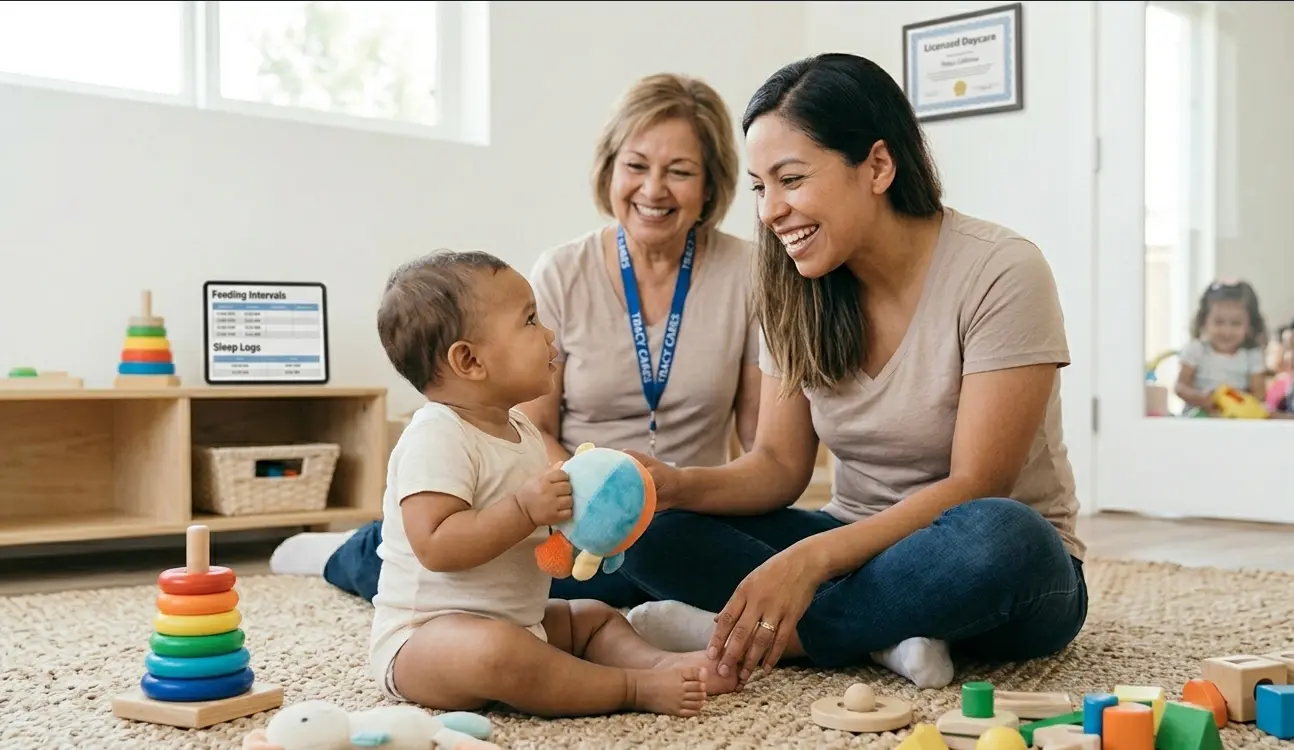
Between 2 and 4 months most infants begin responding actively to voices and sounds in their environment. They turn toward sounds, startle at loud noises, and calm when they hear familiar voices. By 4 months many babies are cooing and beginning to engage in the back and forth vocal exchanges that researchers call serve and return interactions, which the Harvard Center on the Developing Child identifies as one of the most critical building blocks of early brain development.
A baby who is responsive to voices and environmental sounds is ready to benefit from the rich sensory and social environment of a quality infant room. In a licensed Tracy infant daycare, your baby will be surrounded by the voices of consistent caregivers, the sounds of other babies, music, and age-appropriate sensory activities. For a baby who is already responsive and curious about sound, this environment is genuinely stimulating in all the right ways.
If your baby is not yet consistently responding to voices or sounds by 4 months, that is worth discussing with your pediatrician before beginning daycare enrollment. Your child’s pediatrician, along with early intervention specialists connected to the San Joaquin County Office of Education, can provide developmental screenings and guidance if there are any concerns.
Sign 5 — Your Baby Has Received Their First Round of Vaccinations
This sign is less about behavior and more about biology, but it belongs on this list because it is genuinely important for your infant’s health and for the health of every other child in a shared daycare environment.
The American Academy of Pediatrics recommends that infants receive their first round of vaccinations at 2 months of age. This schedule includes protection against several serious illnesses including Haemophilus influenzae type b, pneumococcal disease, rotavirus, diphtheria, tetanus, pertussis, and polio. Group care settings like daycare centers naturally involve more exposure to common childhood illnesses, and having this first vaccination milestone completed before or shortly after enrollment provides a meaningful layer of immunological protection.
California childcare licensing regulations under Title 22 require licensed daycare centers to maintain immunization records for enrolled children and to follow the California Department of Public Health immunization schedule. When you enroll your infant at a licensed Tracy daycare, you will be asked to provide your baby’s vaccination records as part of the enrollment paperwork.
Sign 6 — You Have Established a Secure Bond at Home
This is perhaps the most important readiness sign of all, and it is the one most often overlooked in practical checklists about daycare enrollment.
Attachment research consistently shows that infants who have formed a secure bond with at least one primary caregiver at home are far better equipped to form healthy relationships with new caregivers at daycare. The secure attachment formed at home does not compete with the caregiver relationships your baby will build at your Tracy daycare. It actually enables them.
A securely attached baby has already learned the most fundamental lesson of early childhood: that the world is safe, that adults can be trusted, and that help comes when it is needed. That belief travels with your baby into the infant room at your Tracy childcare center and becomes the foundation on which every new relationship there is built.
This is also why the bond you build with your baby during parental leave, however long or short, is never time wasted from a developmental standpoint. Every responsive feeding, every consistent soothing routine, every moment of face-to-face eye contact you share with your newborn is building the neurological architecture that will make daycare transition easier and more successful.
Signs Your Infant May Need More Time Before Starting Daycare
Just as important as recognizing readiness is recognizing when your baby might benefit from a few more weeks at home before beginning a daycare program. Here are some honest indicators that a brief delay or a very gradual transition might serve your baby better.
Your baby becomes inconsolable for extended periods when separated from you and does not settle for any other caregiver even after repeated attempts. This can be a sign that the attachment foundation needs more time to develop before the demands of group care are introduced.
Your baby is currently unwell, recovering from illness, or has a diagnosed medical condition that requires specialized care not yet arranged with your Tracy daycare team. Starting daycare during or immediately after illness adds physical and emotional stress to an already demanding transition.
Your baby has not yet had their 2-month vaccinations and will be entering a group care environment with other infants. Delaying enrollment by even a week or two until after that vaccination milestone is a reasonable protective step.
None of these situations means daycare is the wrong long-term choice. They simply mean the timing could be adjusted slightly to give your baby the best possible start.
How to Use These Signs When Touring Tracy Daycares
Understanding your baby’s readiness is only half of the equation. The other half is finding a Tracy daycare that is genuinely prepared to receive your infant at whatever stage they are at.
When you visit any licensed infant daycare in Tracy, share what you know about your baby’s readiness openly with the director. A program worth enrolling in will use that information to personalize your baby’s transition plan. The best Tracy infant programs offer a gradual enrollment period where your baby spends increasing amounts of time at the center over the first one to two weeks before full enrollment begins. This gradual approach is supported by research and dramatically reduces the stress of transition for both infants and parents.
Ask the director specifically how they handle the first days for a new infant.You can also review our infant daycare tuition and fees in Tracy before your visit so there are no surprises. Ask what their primary caregiver model looks like. Ask how they communicate with you during the day while your baby is settling in. The answers will tell you whether this is a program that truly understands infant development or one that simply processes enrollments.
At Child Daycare Tracy our infant program is built around exactly this kind of individualized, developmentally informed approach to enrollment. We serve families across Tracy CA 95376 and 95377 and we welcome you to come in and see our infant room in person before you make any decision.
What Tracy Pediatricians and Early Childhood Experts Recommend
Pediatricians affiliated with Sutter Health Tracy and Kaiser Permanente Tracy generally align with the American Academy of Pediatrics guidance that quality childcare is safe for healthy infants from 6 weeks of age. They consistently emphasize two things above all others: the vaccination schedule should be on track before group care begins, and the quality of the program matters far more than the specific starting age.
Early childhood specialists connected to the San Joaquin County Office of Education and First 5 San Joaquin, the county’s early childhood advocacy organization funded through California’s Proposition 10, also emphasize that parents should trust their instincts while gathering objective information. If something about a Tracy daycare feels wrong during a tour, that feeling deserves to be honored regardless of how the program looks on paper.
Frequently Asked Questions About Infant Daycare Readiness in Tracy CA
What are the signs an infant is ready for daycare? The key signs include curiosity about new faces, ability to tolerate brief separations, a rough feeding and sleep pattern, responsiveness to voices and sounds, completed 2-month vaccinations, and a secure bond established at home with a primary caregiver.
What age is too young for daycare in California? California law permits licensed daycare centers to enroll infants from 6 weeks of age. Most early childhood professionals suggest that 3 to 6 months is a more developmentally comfortable starting point when families have flexibility around their return to work date.
How do I know if my baby has separation anxiety? Separation anxiety typically emerges between 6 and 9 months and peaks around 12 months. Signs include intense crying when a caregiver leaves the room, clinging behavior, and difficulty settling with unfamiliar people. This is a normal developmental stage and does not mean daycare is the wrong choice. It does mean the transition needs to be handled gradually and consistently.
Will starting daycare early harm my baby’s development? Research including the NICHD Study of Early Child Care does not support the idea that high quality daycare harms infant development. Children in quality programs consistently show strong language development, social skills, and school readiness. The key phrase is high quality. Program quality matters far more than starting age.
How do I prepare my infant for their first day at a Tracy daycare? Visit the center with your baby before the first official day so the environment and faces become familiar. Share detailed written notes with caregivers about feeding cues, sleep preferences, and soothing techniques. Create a consistent drop-off routine and stick to it from day one. Consider a gradual start with shorter days before building to full enrollment.
How does Child Daycare Tracy support new infant enrollments? We offer a personalized gradual enrollment plan for every new infant, assign a primary caregiver to each baby, provide daily digital updates through our parent communication app, and welcome parents to call or check in at any point during the day while their baby is settling in.
Ready to Enroll Your Infant at Child Daycare Tracy?
When you see the readiness signs in your baby and feel that the time is right, the next step is finding a licensed, nurturing, and professionally staffed infant program in Tracy that will care for your child the way you would.
At Child Daycare Tracy we welcome infants from 6 weeks of age into a safe, Montessori-inspired environment with low caregiver ratios, consistent primary caregivers, and daily communication that keeps you connected to your baby’s day from the moment you drop off to the moment you pick up.
Schedule a tour at our Tracy daycare today and see firsthand why Tracy families trust us with their youngest and most precious children.